
Seismic Audio SA-RMSS-32 Mic Splitter
Seismic Audio·Model SA-RMSS-32·seismic-sa-rmss-32
Photos
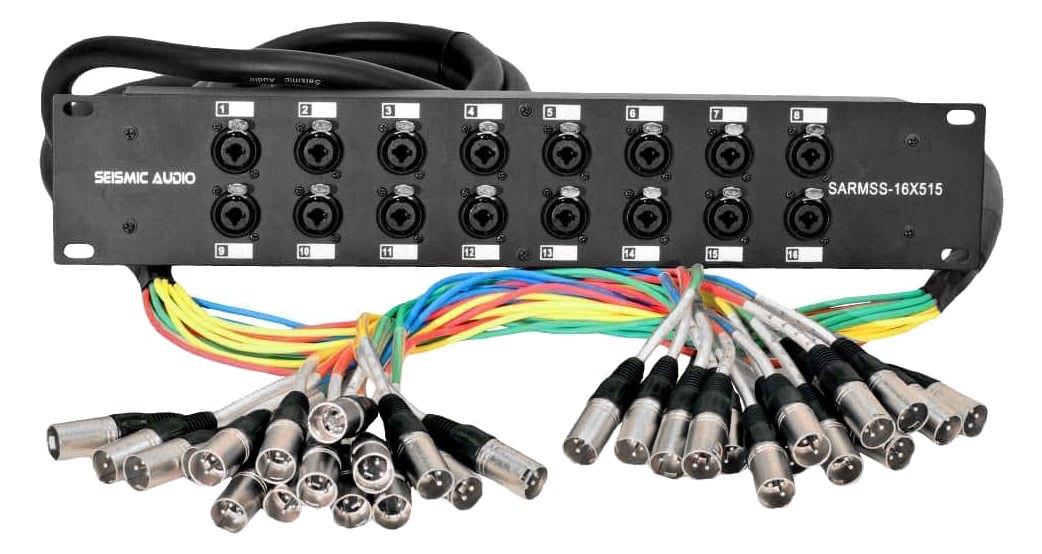
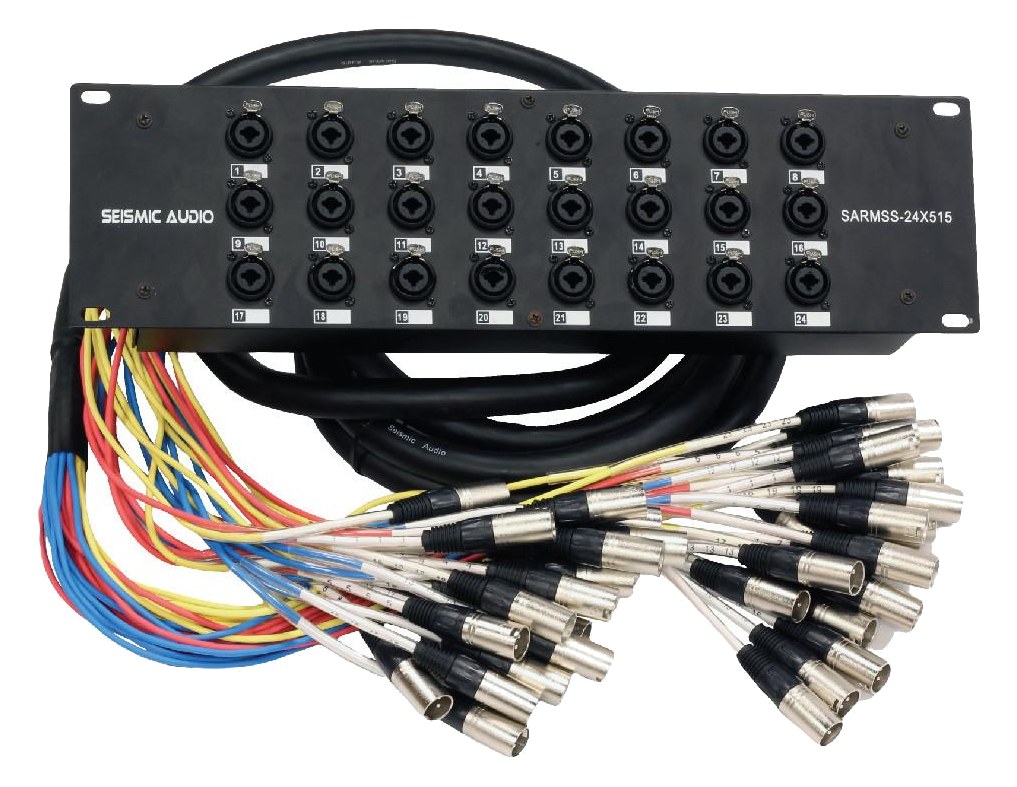
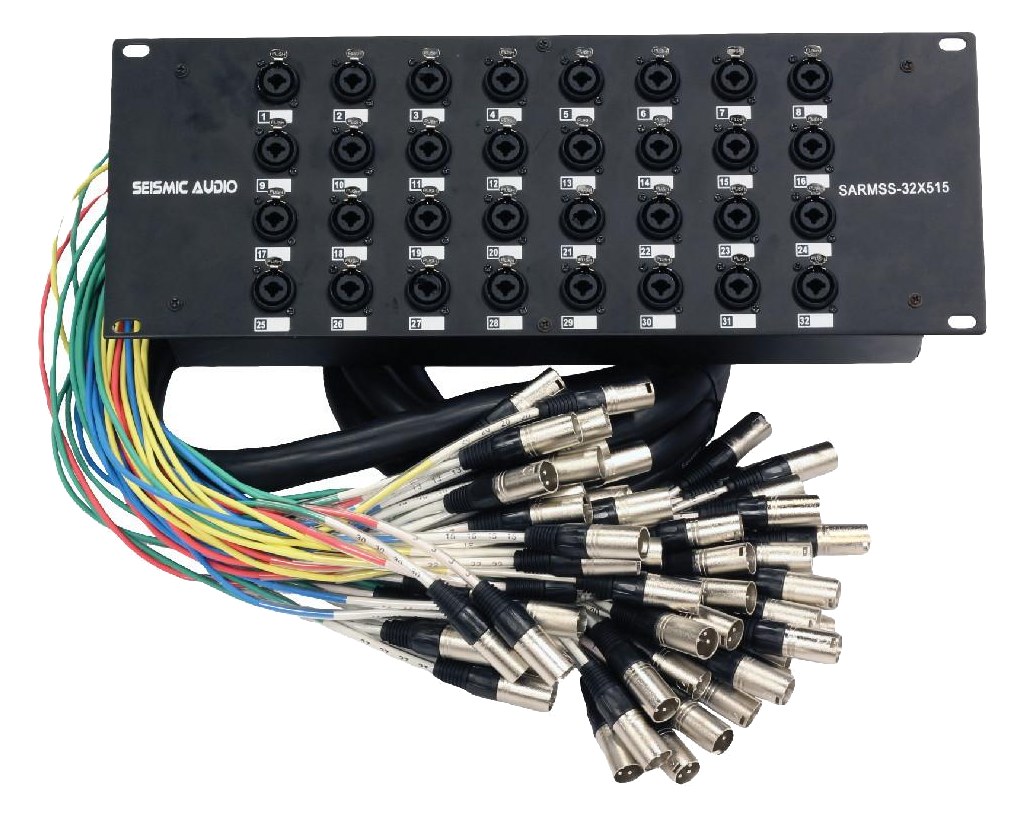
Manufacturer product photography — the drawn faceplate above stays true to panel layout; these show the hardware itself.
About the Seismic Audio SA-RMSS-32
Thirty-two channels of transformer-isolatedA magnetic coupling that passes audio between two windings with no wire contact — isolates splits and kills ground-loop hum, no power needed. splitting in a 5U chassis. The "no compromises" rig pick — every drum mic, every backlineThe band’s on-stage instrument gear — amps, drums, keys. What a venue or festival sometimes supplies so you can travel light. DIDirect Injection box — converts an instrument’s unbalanced signal to a balanced mic-level XLR so it can run long cables without noise., every vocal mic has its own direct + iso trunkThe main multichannel run between stage and console — one fat multicore (or one Cat5e, these days) carrying everything at once. to FOHFront Of House — the main mix the audience hears, and the console position out in the room where it gets mixed. and a recording rig, with margin left over. Heavy enough that you only carry it when the rig calls for it.
The SA-RMSS-32 is the answer to a specific and serious question: how do you feed 32 channels simultaneously to FOHFront Of House — the main mix the audience hears, and the console position out in the room where it gets mixed. and a second destination — a recording truck, a broadcast feed, a monitor worldThe side-stage domain of the monitor engineer — console, IEM racks, and everything feeding the band’s ears instead of the audience. running its own console — without creating a ground-loop mess or loading down a microphone that a vocalist is counting on? Each of the 32 inputs gets both a direct output and a transformer-isolatedA magnetic coupling that passes audio between two windings with no wire contact — isolates splits and kills ground-loop hum, no power needed. output, so you have 64 total output paths leaving this box. That transformer isolation on one leg of every channel is the whole point; it breaks the ground reference between two consoles that may be drawing power from entirely different parts of a venue.
Five rack unitsThe standard slice of rack height: 1U = 1.75″. A 3U box takes three slices; half-rack gear pairs two units side by side in one. and 10.4 kilograms tells you this is not a throw-in-the-fly-pack unit. At load-in it will want its own dedicated trunkThe main multichannel run between stage and console — one fat multicore (or one Cat5e, these days) carrying everything at once. space and two people lifting it into position. The zero power draw is a real operational benefit — no IECThe standard three-prong appliance power inlet on rack gear — the kettle lead. C13/C14 in spec-sheet speak. cable to chase, no power strip slot consumed, no thermal concern in a packed rack. The 220mm depth is manageable in most standard road cases, but measure your rails before you commit. With 96 XLRThe standard 3-pin locking connector for mics and balanced line signals — pin 1 is the shield, pins 2 and 3 carry the balanced pair. connectors populated at show time, patching this unit is its own task; build that time into your advance.
This box belongs in a festival-advance or touring splitter rack where the channel count genuinely reaches into the thirties and two or more consoles need to work from the same mic lines without argument. If your show is a 16-channel club rig or a corporate event with a single FOHFront Of House — the main mix the audience hears, and the console position out in the room where it gets mixed. console, you are carrying 10 kilograms of hardware you do not need. For those situations, a 16-channel splitter or a smaller passive split solution is the honest answer. Where the SA-RMSS-32 earns its place is the situation where the alternative is running two separate mic runs to the stage — and nobody wants to do that.
In the rack
- Assign the direct outputs to whichever console holds phantom powerThe +48 V a console sends up the mic cable to power condenser mics and active DI boxes — invisible to gear that doesn’t need it. responsibility — typically FOHFront Of House — the main mix the audience hears, and the console position out in the room where it gets mixed. — so phantom passes through unimpeded; the isolated outputs go to the secondary destination where phantom is blocked by the transformersA magnetic coupling that passes audio between two windings with no wire contact — isolates splits and kills ground-loop hum, no power needed..
- Color-code your snakeA multicore cable bundling many channels into one stage-to-console run. A sub-snake collects one corner of the stage into a drop box. tails before the gig: one color for the 32 inputs from stage, a second for the 32 direct runs to FOHFront Of House — the main mix the audience hears, and the console position out in the room where it gets mixed., a third for the 32 isolated runs to the split destination. With 96 connectors live, unlabeled cable is a real troubleshooting problem mid-show.
- At 10.4 kg this unit shifts the rack's center of gravity meaningfully — rack it low and towards the back of the case to keep the overall pack balancedCarries the signal on two wires and cancels whatever noise both pick up — why mic cables can run hundreds of feet hum-free. when rolling it on casters.
- Build a channel-by-channel continuity check into your line checkThe quick pre-show pass confirming every input reaches the console, one line at a time. Not a soundcheck — just does it work. routine; with this many connectors, a single misseated XLRThe standard 3-pin locking connector for mics and balanced line signals — pin 1 is the shield, pins 2 and 3 carry the balanced pair. is easy to miss visually but will surface fast when you try to ring out a channel at FOHFront Of House — the main mix the audience hears, and the console position out in the room where it gets mixed..
32-channel transformer-isolatedA magnetic coupling that passes audio between two windings with no wire contact — isolates splits and kills ground-loop hum, no power needed. splitter — festival-grade.
I/O Ports (96)
| Port | Connector | Direction | Signal | Channels |
|---|---|---|---|---|
| Input 1 (XLR) | XLR FEMALE | input | analog audio | — |
| Input 2 (XLR) | XLR FEMALE | input | analog audio | — |
| Input 3 (XLR) | XLR FEMALE | input | analog audio | — |
| Input 4 (XLR) | XLR FEMALE | input | analog audio | — |
| Input 5 (XLR) | XLR FEMALE | input | analog audio | — |
| Input 6 (XLR) | XLR FEMALE | input | analog audio | — |
| Input 7 (XLR) | XLR FEMALE | input | analog audio | — |
| Input 8 (XLR) | XLR FEMALE | input | analog audio | — |
| Input 9 (XLR) | XLR FEMALE | input | analog audio | — |
| Input 10 (XLR) | XLR FEMALE | input | analog audio | — |
| Input 11 (XLR) | XLR FEMALE | input | analog audio | — |
| Input 12 (XLR) | XLR FEMALE | input | analog audio | — |
| Input 13 (XLR) | XLR FEMALE | input | analog audio | — |
| Input 14 (XLR) | XLR FEMALE | input | analog audio | — |
| Input 15 (XLR) | XLR FEMALE | input | analog audio | — |
| Input 16 (XLR) | XLR FEMALE | input | analog audio | — |
| Input 17 (XLR) | XLR FEMALE | input | analog audio | — |
| Input 18 (XLR) | XLR FEMALE | input | analog audio | — |
| Input 19 (XLR) | XLR FEMALE | input | analog audio | — |
| Input 20 (XLR) | XLR FEMALE | input | analog audio | — |
| Input 21 (XLR) | XLR FEMALE | input | analog audio | — |
| Input 22 (XLR) | XLR FEMALE | input | analog audio | — |
| Input 23 (XLR) | XLR FEMALE | input | analog audio | — |
| Input 24 (XLR) | XLR FEMALE | input | analog audio | — |
| Input 25 (XLR) | XLR FEMALE | input | analog audio | — |
| Input 26 (XLR) | XLR FEMALE | input | analog audio | — |
| Input 27 (XLR) | XLR FEMALE | input | analog audio | — |
| Input 28 (XLR) | XLR FEMALE | input | analog audio | — |
| Input 29 (XLR) | XLR FEMALE | input | analog audio | — |
| Input 30 (XLR) | XLR FEMALE | input | analog audio | — |
| Input 31 (XLR) | XLR FEMALE | input | analog audio | — |
| Input 32 (XLR) | XLR FEMALE | input | analog audio | — |
| Direct Out 1 (XLR) | XLR MALE | output | analog audio | — |
| Direct Out 2 (XLR) | XLR MALE | output | analog audio | — |
| Direct Out 3 (XLR) | XLR MALE | output | analog audio | — |
| Direct Out 4 (XLR) | XLR MALE | output | analog audio | — |
| Direct Out 5 (XLR) | XLR MALE | output | analog audio | — |
| Direct Out 6 (XLR) | XLR MALE | output | analog audio | — |
| Direct Out 7 (XLR) | XLR MALE | output | analog audio | — |
| Direct Out 8 (XLR) | XLR MALE | output | analog audio | — |
| Direct Out 9 (XLR) | XLR MALE | output | analog audio | — |
| Direct Out 10 (XLR) | XLR MALE | output | analog audio | — |
| Direct Out 11 (XLR) | XLR MALE | output | analog audio | — |
| Direct Out 12 (XLR) | XLR MALE | output | analog audio | — |
| Direct Out 13 (XLR) | XLR MALE | output | analog audio | — |
| Direct Out 14 (XLR) | XLR MALE | output | analog audio | — |
| Direct Out 15 (XLR) | XLR MALE | output | analog audio | — |
| Direct Out 16 (XLR) | XLR MALE | output | analog audio | — |
| Direct Out 17 (XLR) | XLR MALE | output | analog audio | — |
| Direct Out 18 (XLR) | XLR MALE | output | analog audio | — |
| Direct Out 19 (XLR) | XLR MALE | output | analog audio | — |
| Direct Out 20 (XLR) | XLR MALE | output | analog audio | — |
| Direct Out 21 (XLR) | XLR MALE | output | analog audio | — |
| Direct Out 22 (XLR) | XLR MALE | output | analog audio | — |
| Direct Out 23 (XLR) | XLR MALE | output | analog audio | — |
| Direct Out 24 (XLR) | XLR MALE | output | analog audio | — |
| Direct Out 25 (XLR) | XLR MALE | output | analog audio | — |
| Direct Out 26 (XLR) | XLR MALE | output | analog audio | — |
| Direct Out 27 (XLR) | XLR MALE | output | analog audio | — |
| Direct Out 28 (XLR) | XLR MALE | output | analog audio | — |
| Direct Out 29 (XLR) | XLR MALE | output | analog audio | — |
| Direct Out 30 (XLR) | XLR MALE | output | analog audio | — |
| Direct Out 31 (XLR) | XLR MALE | output | analog audio | — |
| Direct Out 32 (XLR) | XLR MALE | output | analog audio | — |
| Isolated Out 1 (XLR) | XLR MALE | output | analog audio | — |
| Isolated Out 2 (XLR) | XLR MALE | output | analog audio | — |
| Isolated Out 3 (XLR) | XLR MALE | output | analog audio | — |
| Isolated Out 4 (XLR) | XLR MALE | output | analog audio | — |
| Isolated Out 5 (XLR) | XLR MALE | output | analog audio | — |
| Isolated Out 6 (XLR) | XLR MALE | output | analog audio | — |
| Isolated Out 7 (XLR) | XLR MALE | output | analog audio | — |
| Isolated Out 8 (XLR) | XLR MALE | output | analog audio | — |
| Isolated Out 9 (XLR) | XLR MALE | output | analog audio | — |
| Isolated Out 10 (XLR) | XLR MALE | output | analog audio | — |
| Isolated Out 11 (XLR) | XLR MALE | output | analog audio | — |
| Isolated Out 12 (XLR) | XLR MALE | output | analog audio | — |
| Isolated Out 13 (XLR) | XLR MALE | output | analog audio | — |
| Isolated Out 14 (XLR) | XLR MALE | output | analog audio | — |
| Isolated Out 15 (XLR) | XLR MALE | output | analog audio | — |
| Isolated Out 16 (XLR) | XLR MALE | output | analog audio | — |
| Isolated Out 17 (XLR) | XLR MALE | output | analog audio | — |
| Isolated Out 18 (XLR) | XLR MALE | output | analog audio | — |
| Isolated Out 19 (XLR) | XLR MALE | output | analog audio | — |
| Isolated Out 20 (XLR) | XLR MALE | output | analog audio | — |
| Isolated Out 21 (XLR) | XLR MALE | output | analog audio | — |
| Isolated Out 22 (XLR) | XLR MALE | output | analog audio | — |
| Isolated Out 23 (XLR) | XLR MALE | output | analog audio | — |
| Isolated Out 24 (XLR) | XLR MALE | output | analog audio | — |
| Isolated Out 25 (XLR) | XLR MALE | output | analog audio | — |
| Isolated Out 26 (XLR) | XLR MALE | output | analog audio | — |
| Isolated Out 27 (XLR) | XLR MALE | output | analog audio | — |
| Isolated Out 28 (XLR) | XLR MALE | output | analog audio | — |
| Isolated Out 29 (XLR) | XLR MALE | output | analog audio | — |
| Isolated Out 30 (XLR) | XLR MALE | output | analog audio | — |
| Isolated Out 31 (XLR) | XLR MALE | output | analog audio | — |
| Isolated Out 32 (XLR) | XLR MALE | output | analog audio | — |
Deciding between two?
Rack space, watts, weight and every connector, side by side.
Related gear
Related articles
Guides from our library that cover planning around splitter gear.
A walking tour of the signal path from microphone to in-ear monitor, with what every box in the rack actually does to the audio along the way.
A plain-English guide to writing the input list, stage plot, and patch sheet that house engineers want — without the jargon, with examples, and with a free way to generate one.
How to split mic signals between FOH and your IEM rack: transformer-isolated splitters, phantom power rules, and where to place the split in the chain.