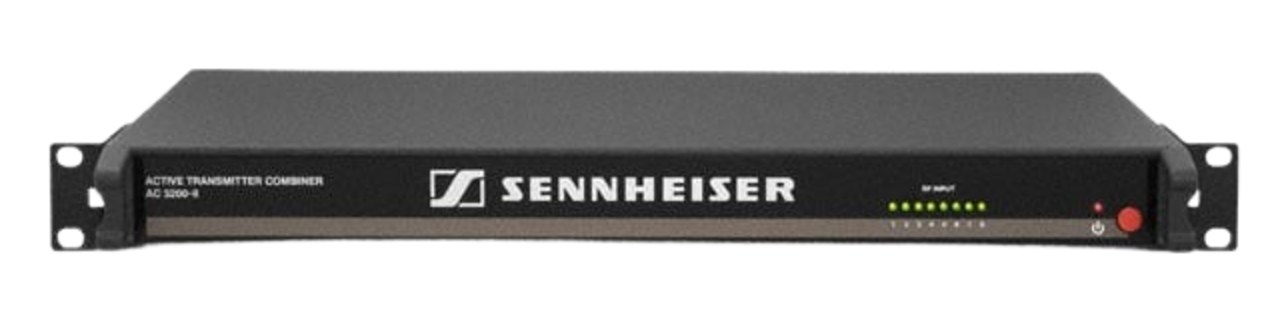
The Sennheiser AC 3200-II is the touring-standard active combiner, putting up to eight IEM transmitters on a single antenna with headroom designed for high-power broadcast and arena use. Cascade ports let two units build a 16-channel system, and the robust RF stages keep intermod products down where cheaper combiners fold. If the monitor rack has a rack of SR 2050s in it, this is usually the box underneath them.
~$4,297Use retailer rows for current price and stock
01 · What it does—and what that changes in your rig.
Product overview
Start with the payoff, then work through how it functions, where it fits, and the details that change a real build.
The payoff
Antenna Distro decisions, organized around the whole rig.
The AC 3200-II is the box that makes a full rack of IEMIn-Ear Monitor — earpieces that replace floor wedges, feeding each player their own mix. The reason this whole rack exists. transmitters share antennas without tearing each other apart. Its job is straightforward on paper — take up to eight transmitter outputs, combine them onto a single antenna feed — but the engineering behind that is anything but simple. Active combining at this density means the unit is doing real work to keep intermodulationIntermodulation — ghost frequencies created when transmitters mix in each other’s electronics. Why multi-channel wireless is calculated, not guessed. products suppressed, and Sennheiser has built the II revision around the headroomThe margin between your normal level and where things clip — headroom is what absorbs the snare hit you didn’t see coming. requirements of arena-scale RFRadio Frequency — the wireless part of wireless. RF planning is why big rigs scan, coordinate, and combine antennas instead of hoping. environments where cheaper passive splitters or lower-grade combinersThe transmit-side twin of a distro: merges several IEM transmitters into one antenna without letting them intermodulate. introduce noise floorsThe constant background hiss a device produces on its own. Everything you pass through it sits on top — lower is better. that eat into your link budget before the signal even reaches the stage.
Documented outputs
1One destination connection
Documented inputs
9Based on documented inputs
Rack space
1UBuilder checks available rail space
Sennheiser product panel1U · 25W
Function
How it works in the path
One rack unitThe standard slice of rack height: 1U = 1.75″. A 3U box takes three slices; half-rack gear pairs two units side by side in one., 380mm deep, drawing up to 35 watts — this thing is not subtle in the rack, and at 5kg it will remind you it exists when you're rolling cases. The cascade port architecture is the practical headline: two AC 3200-IIs chained together give you a 16-transmitter system on a single antenna pair, which covers most touring IEMIn-Ear Monitor — earpieces that replace floor wedges, feeding each player their own mix. The reason this whole rack exists. rigs without a second thought. That single BNCThe twist-lock coax connector used for word clock and antenna runs — it locks, so it can’t be pulled out mid-show. antenna output means your antenna placement decisions are made once, at the combinerThe transmit-side twin of a distro: merges several IEM transmitters into one antenna without letting them intermodulate., and every transmitter in the rack inherits the result — so getting good antennas on good cable with proper gain stagingSetting sensible levels at every step of the chain so nothing clips and nothing drowns in hiss — the unglamorous secret to clean mixes. upstream of this box matters enormously.
Best fit
Where it earns its place in the rack
If you're running six or more IEMIn-Ear Monitor — earpieces that replace floor wedges, feeding each player their own mix. The reason this whole rack exists. transmitters on a serious touring or broadcast rig and you're already invested in Sennheiser's 2000 or 9000 series transmitters, this is the expected choice and the price reflects that pedigree. If you're running four channels at a regional theater or a club residency, the cost is hard to justify and a smaller combinerThe transmit-side twin of a distro: merges several IEM transmitters into one antenna without letting them intermodulate. will serve you. This is also not the box for mixed-manufacturer rigs where you're combining Shure and Sennheiser transmitters — the RFRadio Frequency — the wireless part of wireless. RF planning is why big rigs scan, coordinate, and combine antennas instead of hoping.impedanceOpposition to signal flow, in ohms. Low-impedance IEMs are easier to drive loud; mismatches shift level and tone. and power levels need to be matched, and you should treat this as a Sennheiser ecosystem component.
In the rack
Details worth deciding before load-in.
Plan your rack layout so the AC 3200-II sits directly below or above your transmitter row — shorter BNCThe twist-lock coax connector used for word clock and antenna runs — it locks, so it can’t be pulled out mid-show. jumpers between TX outputs and combinerThe transmit-side twin of a distro: merges several IEM transmitters into one antenna without letting them intermodulate. inputs mean less signal degradation and a cleaner cable dress under load-in pressure.
If you're cascading two units for 16 channels, treat the cascade connection as a critical RFRadio Frequency — the wireless part of wireless. RF planning is why big rigs scan, coordinate, and combine antennas instead of hoping. path, not an afterthought — use a quality low-loss BNCThe twist-lock coax connector used for word clock and antenna runs — it locks, so it can’t be pulled out mid-show. cable of appropriate length and keep it away from power cables to avoid induced noise.
Budget your antenna cable run carefully: the single output BNCThe twist-lock coax connector used for word clock and antenna runs — it locks, so it can’t be pulled out mid-show. is only as good as the cable feeding your antennas. High-loss cable to distant stage-lip antennas will undermine everything the combinerThe transmit-side twin of a distro: merges several IEM transmitters into one antenna without letting them intermodulate. does — use low-loss coax and add an in-line antenna amplifier if the run exceeds roughly 15–20 meters.
Account for the 380mm depth when specifying your road case — this is a deeper-than-average 1UThe standard slice of rack height: 1U = 1.75″. A 3U box takes three slices; half-rack gear pairs two units side by side in one. unit and will not fit in shallow cases sized for standard rack gear.
02 · Know the whole path before you buy.
Signal path
Learn the route as a block diagram: source, product function, transport, and destination. Select any block to see what enters, what changes, and what leaves.
Interactive block diagramAuto-looping · hover, focus, or tap to hold a stage
Port-type signalProduct functionSystem boundary
Follow one signal from source to destination
Each block answers the same three questions: what arrives, what changes here, and what leaves.
01 · Source · selected
bnc + dc barrel
bnc
01 · Source
9 documented inputs
bnc + dc barrel
Arrives as
9 documented inputs
Connector
bnc + dc barrel
Signal
antenna
03 · What this product asks of the rest of the system.
Compatibility
Treat connector names as the start of the check—not the answer. These are the boundaries that determine a complete working path.
Best fit · Antenna Distro
Use it when 1U and 380 mm of depth fit the case.
Plan the companion path
Complete the path with upstream and downstream gear that matches connector, direction, signal type, protocol, and wiring standard.
Connector boundary
Documented connectors: bnc, dc barrel. Match connector, direction, and signal type—not shape alone.
04 · Every connector, grouped by job.
I/O ports
Switch the product view and the documented port inventory updates with it—hardware and data stay side by side.
Every connector, grouped by job.
Switch panels to keep the hardware view and the documented port list in sync.
Front panelRear panel
All documented ports for Sennheiser AC 3200-II Antenna Combiner
Port
Panel
Connector
Direction
Signal
Channels
TX 1 In
rear
bnc
input
antenna
—
TX 2 In
rear
bnc
input
antenna
—
TX 3 In
rear
bnc
input
antenna
—
TX 4 In
rear
bnc
input
antenna
—
TX 5 In
rear
bnc
input
antenna
—
TX 6 In
rear
bnc
input
antenna
—
TX 7 In
rear
bnc
input
antenna
—
TX 8 In
rear
bnc
input
antenna
—
Antenna Out
rear
bnc
output
antenna
—
DC In (NT 12-125D)
rear
dc barrel
input
power
—
Showing 10 of 10 documented physical ports.
05 · Compare the decision, not just the price.
Alternatives
The rows are organized around fit, power, I/O, and system role so a cheaper unit cannot hide a more expensive workflow.
AC 3200-IIThe Sennheiser AC 3200-II is the touring-standard active combiner, putting up to eight IEM transmitters on a single antenna with headroom designed for high-power broadcast and arena use. Cascade ports let two units build a 16-channel system, and the robust RF stages keep intermod products down where cheaper combiners fold. If the monitor rack has a rack of SR 2050s in it, this is usually the box underneath them.View gear →
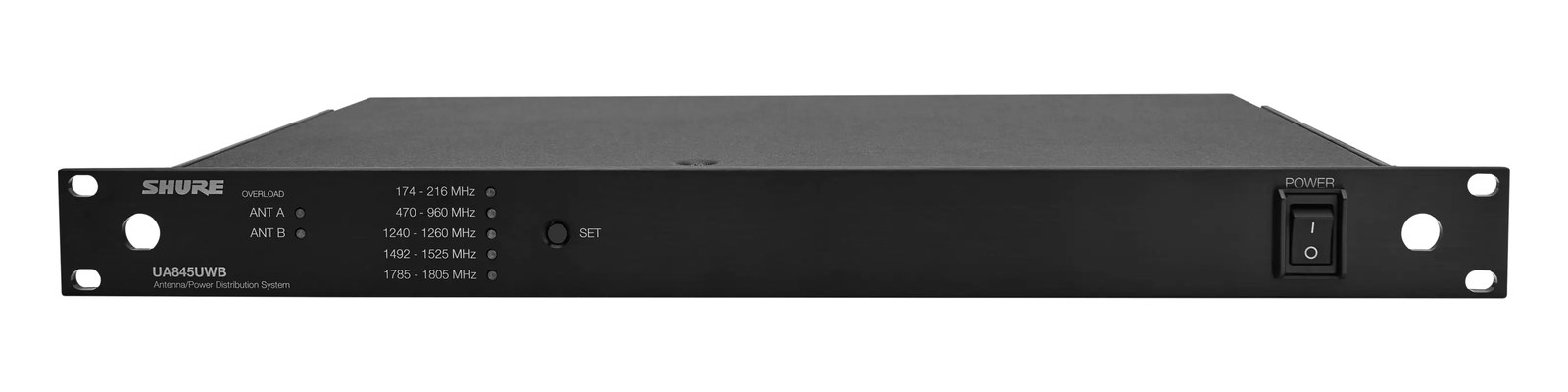
GX8The Professional Wireless GX8 is the gold standard for antenna combining on major touring productions, trusted by RF coordinators worldwide. Its active filtering and combining circuitry handles eight IEM transmitter outputs while maintaining clean, intermod-free signal at the antenna. At 2U it takes more rack space than passive alternatives, but the filtering quality justifies it for large-scale shows where RF reliability is mission-critical.View gear →
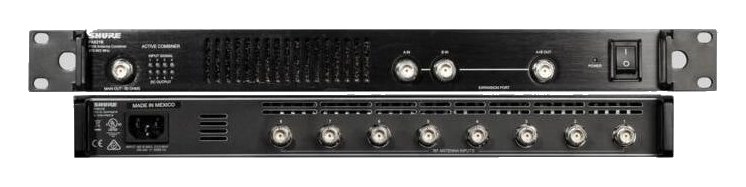
PA821BThe PA821A is the larger sibling of the PA421A, combining eight IEM transmitter outputs into a single antenna pair with active filtering to maintain signal integrity. Built-in bandpass filters help keep your transmitted signals clean and reduce intermod products, which matters in crowded RF environments. This is a touring-grade solution for rigs running six or more IEM channels from a single rack.View gear →
MAT288The Wisycom MAT288 is a top-tier antenna matrix that combines and distributes RF for both IEM transmitters and wireless mic receivers simultaneously in a single rack unit. This dual-purpose design eliminates the need for separate combiner and splitter units, saving significant rack space on large touring rigs. It is a premium investment that pays off when you are managing complex RF environments with many wireless channels across IEM and mic systems.View gear →
06 · Resolve the questions that can change the purchase or build plan.
Planning questions
Short, source-backed answers surface rack fit, power, cabling, and connection details before they become surprises.
How will the Sennheiser AC 3200-II Antenna Combiner affect rack fit and case depth?
It occupies 1U. Its documented depth is 380 mm.
How much power does the Sennheiser AC 3200-II Antenna Combiner draw?
Typical draw is 25W and documented maximum draw is 35W.
What connections does the Sennheiser AC 3200-II Antenna Combiner have?
10 documented physical ports, including TX 1 In, TX 2 In, TX 3 In, TX 4 In, TX 5 In, TX 6 In.
07 · See this unit inside a real rack plan.
Builder preview
Placement is only the start. Builder checks space · depth · weight, power headroom, dependencies, and compatible signal paths around this exact catalog item.Open in Builder