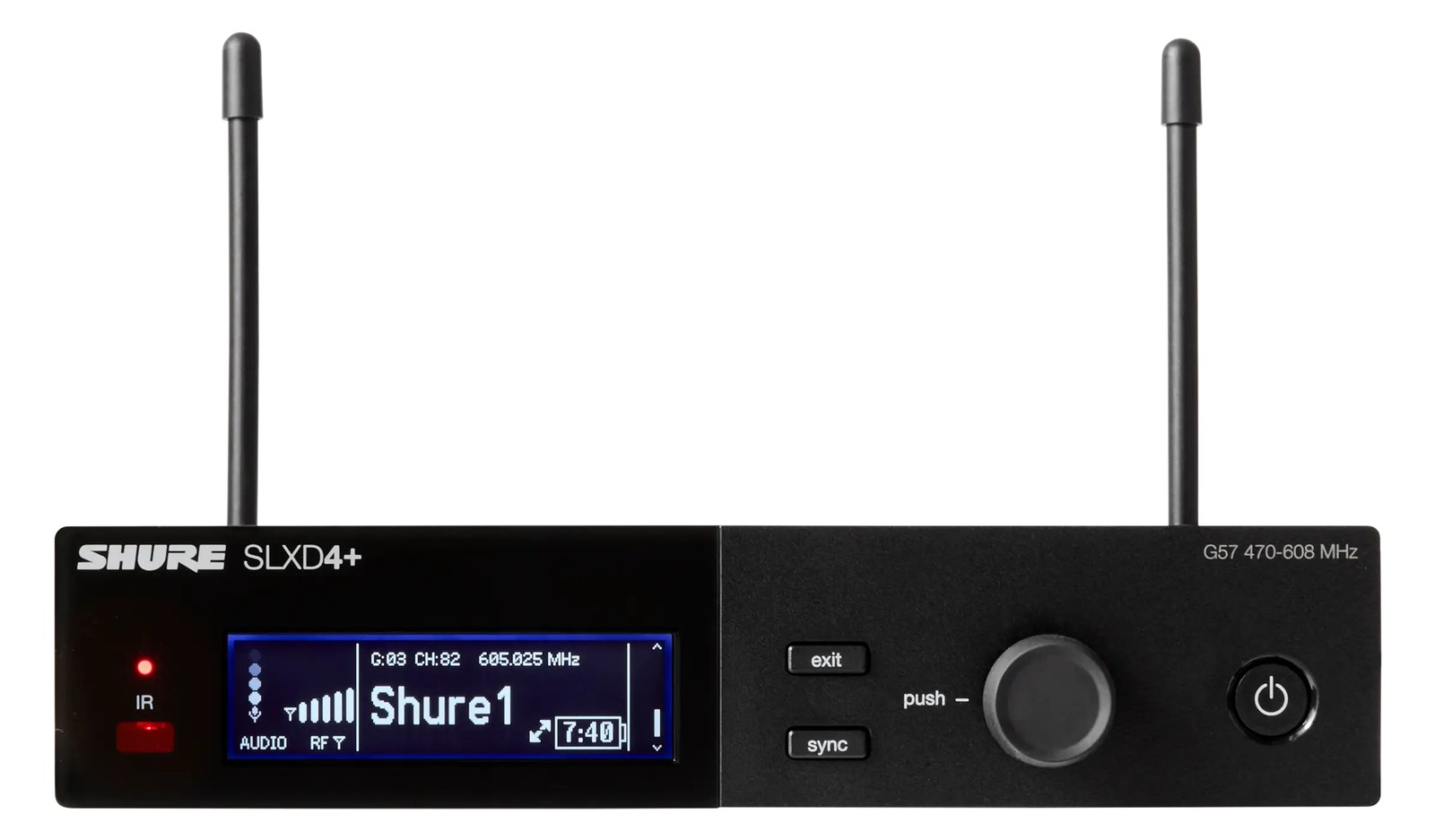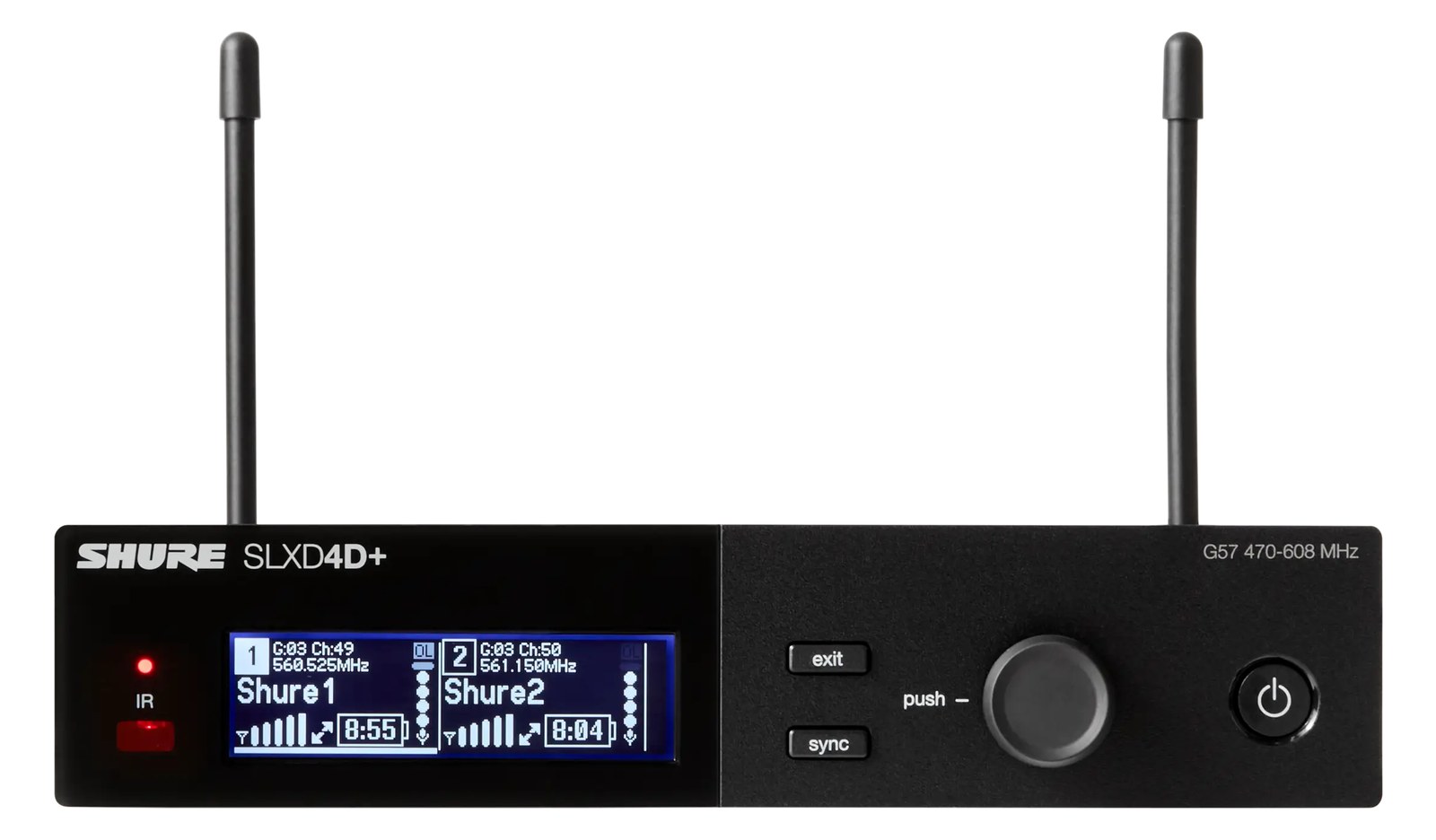

Shure AD4Q Axient Digital Quad Mic Receiver
Shure·Model AD4Q·shure-ad4q-mic
Photos
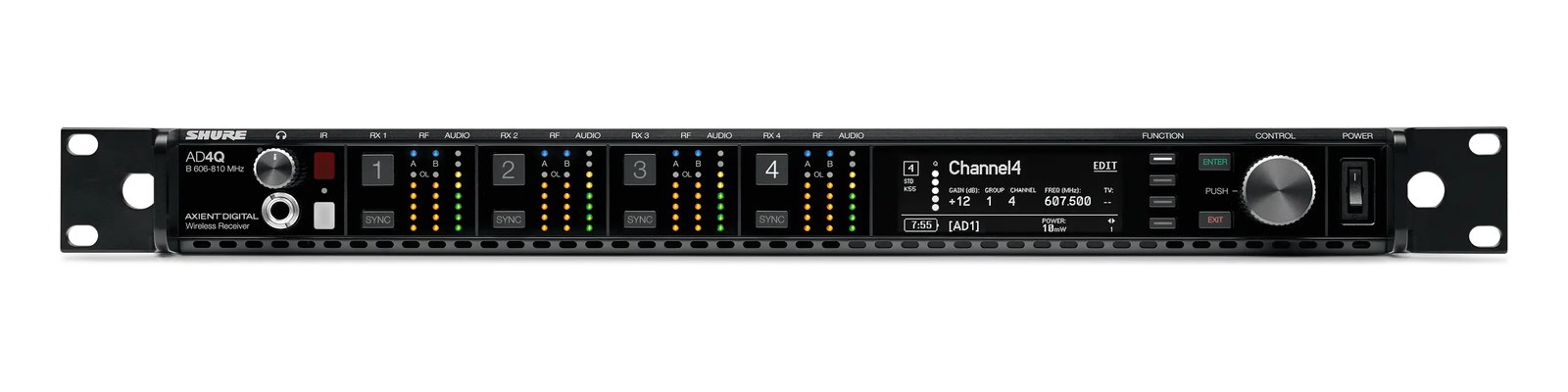
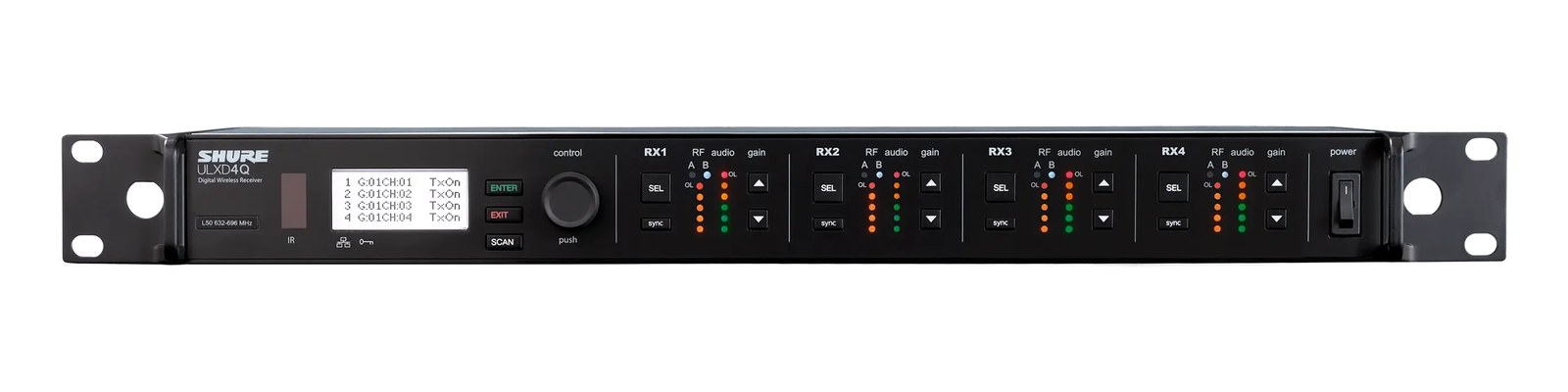
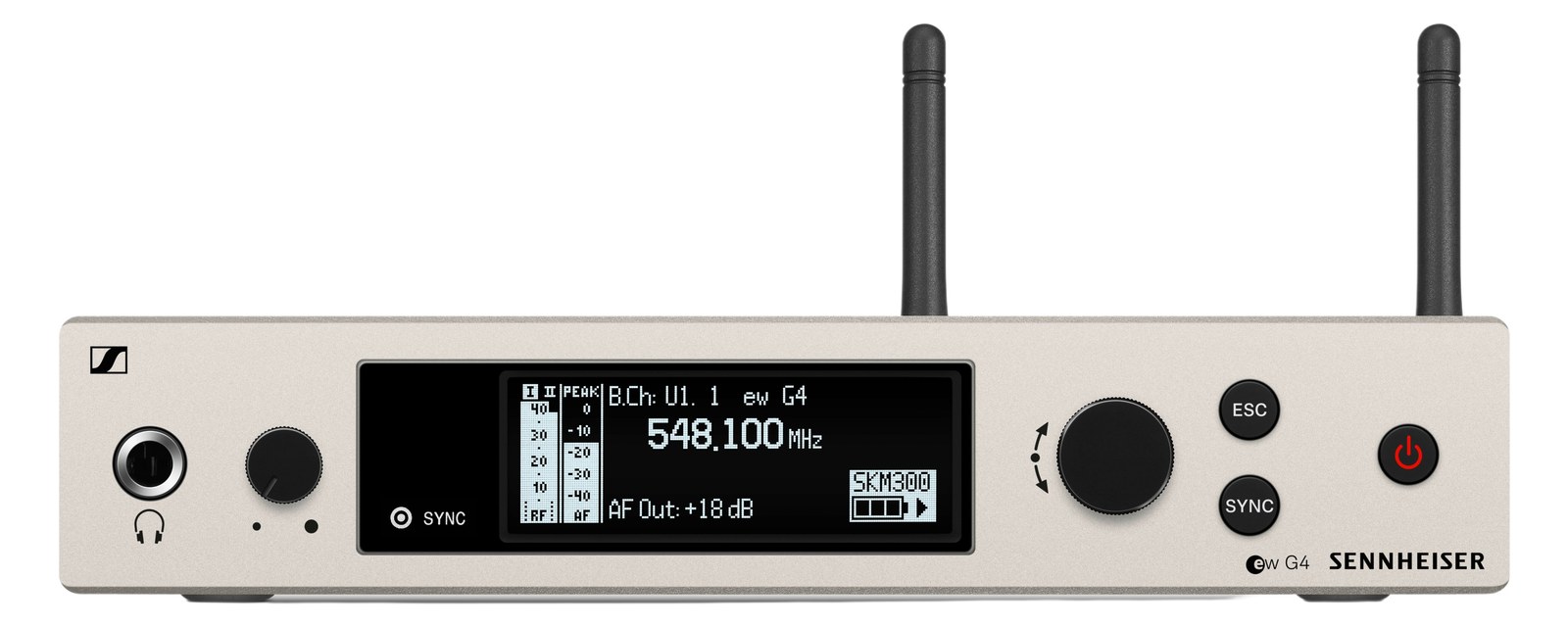
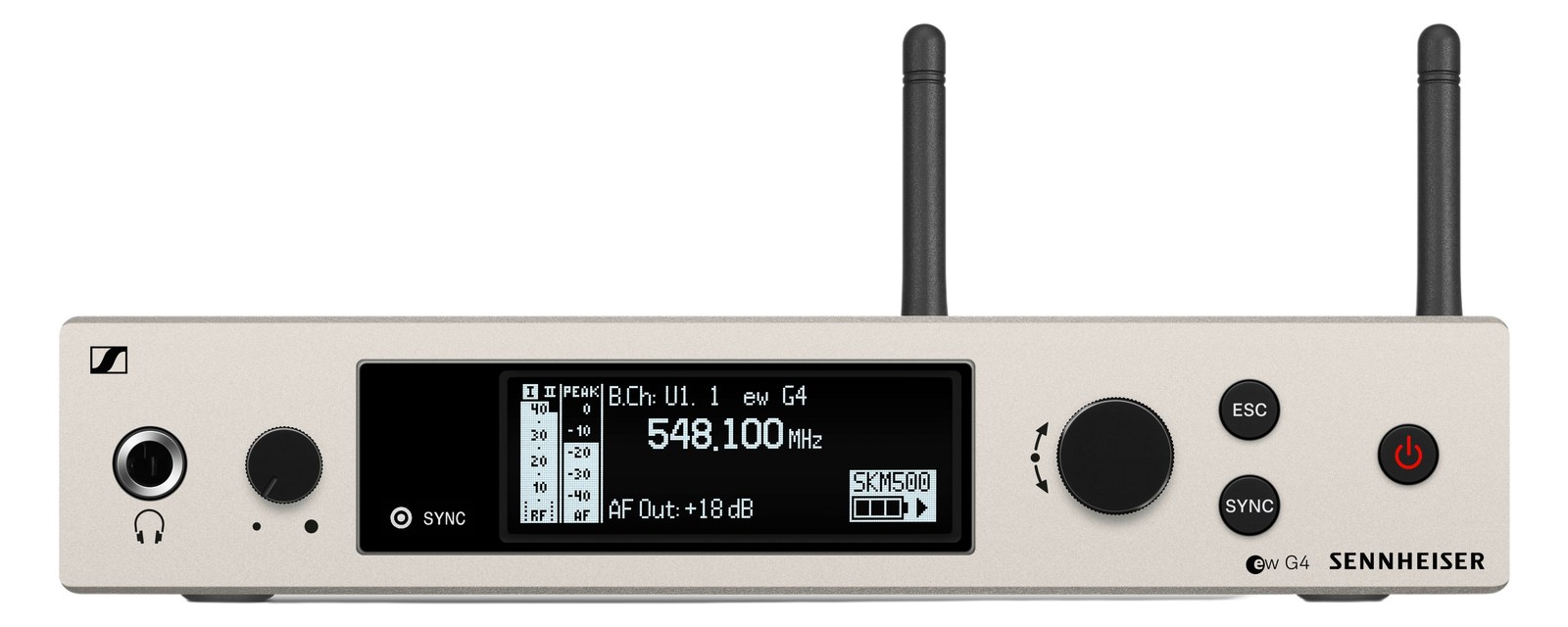
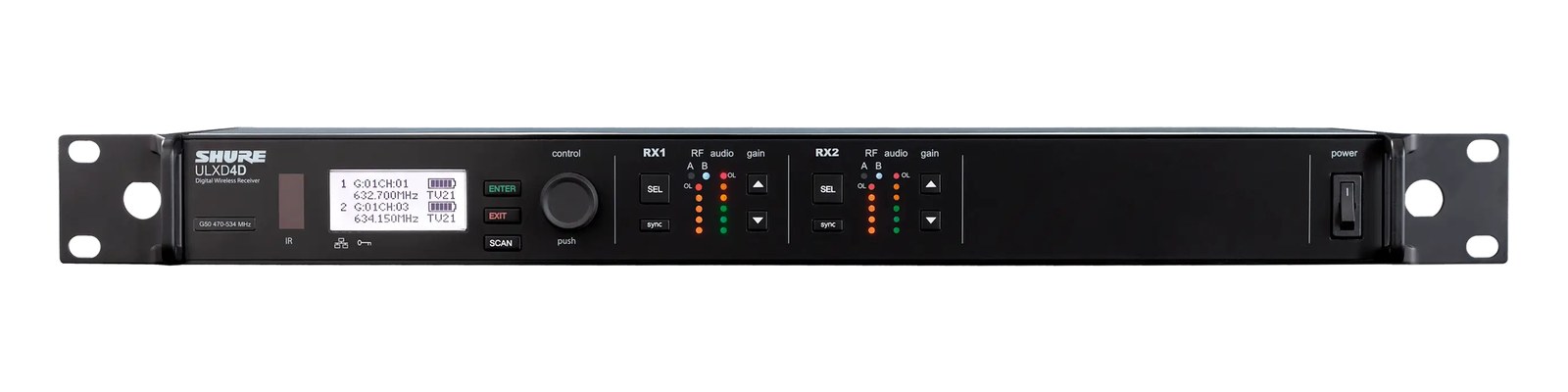
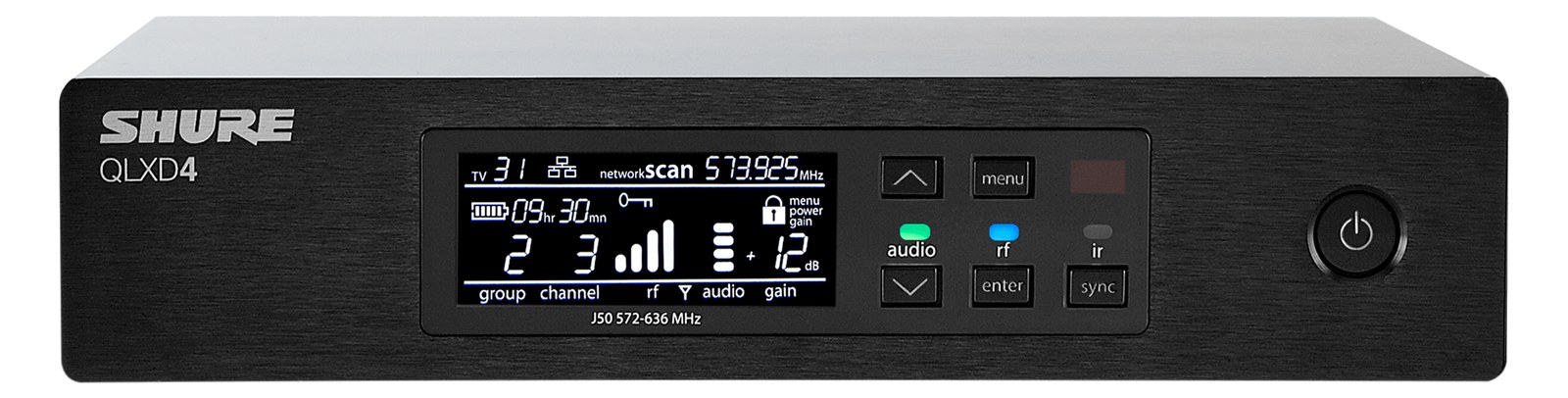
Manufacturer product photography — the drawn faceplate above stays true to panel layout; these show the hardware itself.
About the Shure AD4Q
The AD4Q packs four Axient Digital receiver channels into a single 1UThe standard slice of rack height: 1U = 1.75″. A 3U box takes three slices; half-rack gear pairs two units side by side in one. rack space with full DanteThe most common audio-over-network standard: dozens of channels of uncompressed digital audio down one ordinary Ethernet cable between Dante boxes., ShowLink, and Quadversity support, making it the ultimate high-density wireless mic solution. For large touring productions and broadcast events with many wireless channels, this dramatically reduces the rack space and antenna infrastructure needed. The price per channel is significant, but the reliability and feature set are unmatched in professional wireless.
The AD4Q is Shure's quad-channel receiver in the Axient Digital line — four independent wireless mic channels in a single 2UThe standard slice of rack height: 1U = 1.75″. A 3U box takes three slices; half-rack gear pairs two units side by side in one. chassis, each with its own analog XLRThe standard 3-pin locking connector for mics and balanced line signals — pin 1 is the shield, pins 2 and 3 carry the balanced pair. output and all four simultaneously available over DanteThe most common audio-over-network standard: dozens of channels of uncompressed digital audio down one ordinary Ethernet cable between Dante boxes.. In a large touring or broadcast rig where you might need twelve, sixteen, or twenty wireless channels, that density changes the math on rack real estate, antenna runs, and system complexity. This is the unit you spec when the input count is high, the frequency coordinationCalculating a set of wireless frequencies that won’t interfere with each other or local TV — the homework behind a clean RF night. is tight, and failure is not an acceptable outcome.
Thirty-five watts steady draw across four active channels is efficient at that density — plan for the 42W maximum when all four channels are working hard and factor it honestly into your power budget. The 340mm depth is substantial, so check your rack depth before committing, particularly in a shallow fly pack. DanteThe most common audio-over-network standard: dozens of channels of uncompressed digital audio down one ordinary Ethernet cable between Dante boxes. Primary and Secondary ports give you redundantA second copy of anything critical — supply, computer, network path — already running so one failure can’t stop the show. network audio paths without a breakoutA cable that splits one multichannel connector (like a DB25) into individual plugs — the octopus that turns 8 channels into 8 XLRs. box, ShowLink lets you push transmitter changes from front-of-houseFront Of House — the main mix the audience hears, and the console position out in the room where it gets mixed. without touching the rack, and Quadversity mode — when you have the antenna infrastructure to support it — adds a fourth diversityA receiver with two antennas and two radio sections that continuously picks the stronger one — the difference between a dropout and a show. path for environments where two-antenna setups leave you exposed.
If you're running four or more Axient Digital channels and can justify the per-channel cost, the AD4Q is the right answer: it consolidates infrastructure, simplifies cable management, and keeps everything inside one managed ecosystem. If you only need one or two channels, the single or dual Axient Digital receivers will serve you without the price commitment. And if your budget ceiling is hard, look seriously at the ULX-D or SLX-D lines — the AD4Q's value is in density and Quadversity capability, not entry-level wireless.
In the rack
- Run your antenna distroOne pair of antennas feeding many receivers through an amplified splitter — replaces the forest of whips and keeps RF levels consistent. to the two BNCThe twist-lock coax connector used for word clock and antenna runs — it locks, so it can’t be pulled out mid-show. inputs on this unit rather than cabling direct from the antennas — at quad density you'll want the distribution headroomThe margin between your normal level and where things clip — headroom is what absorbs the snare hit you didn’t see coming., and it keeps your antenna runs consistent across the rack.
- Assign all four DanteThe most common audio-over-network standard: dozens of channels of uncompressed digital audio down one ordinary Ethernet cable between Dante boxes. channels to your Primary network path first and confirm Secondary failoverThe automatic switch to the backup when the primary dies — good failover is seamless enough that the audience never knows. before doors open; with redundantA second copy of anything critical — supply, computer, network path — already running so one failure can’t stop the show. EtherConAn Ethernet plug inside a rugged XLR-style locking shell — tour-grade network connections that can’t be yanked loose. paths available, there's no reason not to have both wired and tested.
- Use ShowLink early in advance of soundcheck to verify remote transmitter control reaches every position on your stage — knowing your RFRadio Frequency — the wireless part of wireless. RF planning is why big rigs scan, coordinate, and combine antennas instead of hoping. coverage map before the show removes one variable when things get busy.
- At 340mm deep, verify your rack case has adequate rear clearance for EtherConAn Ethernet plug inside a rugged XLR-style locking shell — tour-grade network connections that can’t be yanked loose. connectors and XLRThe standard 3-pin locking connector for mics and balanced line signals — pin 1 is the shield, pins 2 and 3 carry the balanced pair. breakoutsA cable that splits one multichannel connector (like a DB25) into individual plugs — the octopus that turns 8 channels into 8 XLRs. without forcing a bend on any cable; a shallow gig bag will cause problems here.
Axient Digital quad-channel receiver. Four channels in 1UThe standard slice of rack height: 1U = 1.75″. A 3U box takes three slices; half-rack gear pairs two units side by side in one., full DanteThe most common audio-over-network standard: dozens of channels of uncompressed digital audio down one ordinary Ethernet cable between Dante boxes. and ShowLink.
I/O Ports (23)
| Port | Connector | Direction | Signal | Channels |
|---|---|---|---|---|
| XLR Out 1 | XLR MALE | output | analog audio | — |
| XLR Out 2 | XLR MALE | output | analog audio | — |
| XLR Out 3 | XLR MALE | output | analog audio | — |
| XLR Out 4 | XLR MALE | output | analog audio | — |
| 1/4" Out 1 (-10dB) | TRS QUARTER | output | analog audio | — |
| 1/4" Out 2 (-10dB) | TRS QUARTER | output | analog audio | — |
| 1/4" Out 3 (-10dB) | TRS QUARTER | output | analog audio | — |
| 1/4" Out 4 (-10dB) | TRS QUARTER | output | analog audio | — |
| AES3 1&2 Out | AES3 XLR | output | digital audio | 2 |
| AES3 3&4 Out | AES3 XLR | output | digital audio | 2 |
| Antenna A | BNC | input | antenna | — |
| Antenna B | BNC | input | antenna | — |
| Antenna Cascade Out C | BNC | output | antenna | — |
| Antenna Cascade Out D | BNC | output | antenna | — |
| Dante Primary | DANTE RJ45 | bidirectional | digital audio | 4 |
| Dante Secondary | DANTE RJ45 | bidirectional | digital audio | 4 |
| Ctrl 1 (PoE) | RJ45 | bidirectional | data | — |
| Ctrl 2 (PoE) | RJ45 | bidirectional | data | — |
| ShowLink (retired — via AD610 on ctrl) | SMA | bidirectional | data | — |
| Word Clock In (BNC) | BNC | input | digital audio | — |
| Word Clock Thru (BNC) | BNC | output | digital audio | — |
- Power (IEC locking) (IEC C14)
- AC Power Cascade Out (IEC) (IEC C14)
Deciding between two?
Rack space, watts, weight and every connector, side by side.
Related gear


Related articles
Guides from our library that cover planning around wireless mic gear.
Why sealed IEMs make you feel disconnected from the room — and exactly how to put the audience back into your mix with one or two well-placed mics.
Why your wireless mics and IEMs need a frequency plan, what intermodulation means in practice, and how to coordinate channels for a clean show.
When you need a combiner vs a distro, active vs passive, cable choice and length math, and how to scale a 4-pack rig into an 8 or 12-pack without intermod nightmares.