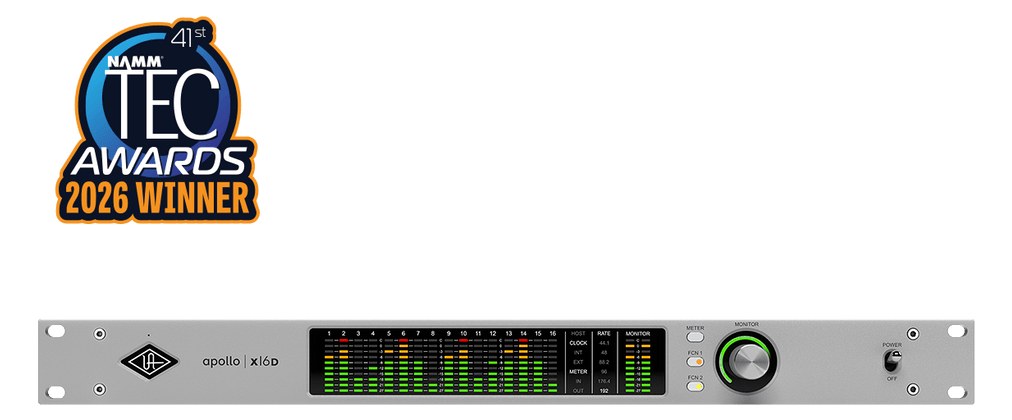
The Apollo x16D swaps the x16's analog-only rear for Dante network I/O, putting UAD conversion and DSP directly on the audio network a modern monitor or playback rig already runs. Thunderbolt to the computer, redundant Dante to the rig, and the same HEXA Core processing as the flagship. For Dante-backbone rigs it removes a format-conversion box from the chain. Found missing by the gear-fit auditor.
~$2,999Use retailer rows for current price and stock
01 · What it does—and what that changes in your rig.
Product overview
Start with the payoff, then work through how it functions, where it fits, and the details that change a real build.
The payoff
Audio Interface decisions, organized around the whole rig.
The Apollo x16D is Universal Audio's answer to a specific problem: you're running a DanteThe most common audio-over-network standard: dozens of channels of uncompressed digital audio down one ordinary Ethernet cable between Dante boxes. backbone across your rig, and you need high-quality conversion and UAD DSPDigital Signal Processing — the number-crunching that does EQ, compression, and effects inside a box. More DSP means more processing at once. processing without bolting a separate format-conversion box into the chain. One rack unitThe standard slice of rack height: 1U = 1.75″. A 3U box takes three slices; half-rack gear pairs two units side by side in one., Thunderbolt 3 to the host computer, and two EtherConAn Ethernet plug inside a rugged XLR-style locking shell — tour-grade network connections that can’t be yanked loose. ports for primary and redundantA second copy of anything critical — supply, computer, network path — already running so one failure can’t stop the show. Dante — that's the architecture. It fits the role of central conversion hub in a monitor rig or playback rack where the rest of your network gear is already speaking Dante, and it brings HEXA Core UAD processing along for the ride so your host machine isn't carrying that load alone.
Documented outputs
1One destination connection
Documented inputs
2Based on documented inputs
Rack space
1UBuilder checks available rail space
Universal Audio product panel1U · 30W
Function
How it works in the path
At 30 watts idle and a 72-watt ceiling, it's well-behaved on a conditioned circuit and won't stress a standard rack power budget. The 305mm depth is typical for a 1UThe standard slice of rack height: 1U = 1.75″. A 3U box takes three slices; half-rack gear pairs two units side by side in one. pro interface — measure your shallower touring racks before assuming it fits. The redundantA second copy of anything critical — supply, computer, network path — already running so one failure can’t stop the show.DanteThe most common audio-over-network standard: dozens of channels of uncompressed digital audio down one ordinary Ethernet cable between Dante boxes. ports matter at show time: primary goes down, secondary keeps audio moving without a console tap or a panic reboot. Word clockThe shared heartbeat keeping every digital box sampling in lockstep. One device leads, the rest follow — or you get clicks and pops. in and out via BNCThe twist-lock coax connector used for word clock and antenna runs — it locks, so it can’t be pulled out mid-show. means you can slot this into an existing house sync topology or drive downstream gear from it. What it is not is a standalone stageboxThe I/O endpoint on stage: mics plug in there and one digital line (AES50, Dante) carries everything to the console. The snake, digitized. — there are no local analog inputs or outputs on the Dante-equipped rear, so everything comes and goes over the network.
Best fit
Where it earns its place in the rack
This box belongs in the rack of an engineer who has already committed to a DanteThe most common audio-over-network standard: dozens of channels of uncompressed digital audio down one ordinary Ethernet cable between Dante boxes. infrastructure and wants UA conversion quality plus UAD plug-in DSPDigital Signal Processing — the number-crunching that does EQ, compression, and effects inside a box. More DSP means more processing at once. without a redundantA second copy of anything critical — supply, computer, network path — already running so one failure can’t stop the show. conversion stage eating headroomThe margin between your normal level and where things clip — headroom is what absorbs the snare hit you didn’t see coming. and rack space. If your rig is MADIA pro digital format carrying 64 channels on one coax or optical cable. Point-to-point — one sender, one receiver, no network required.-based, or if you need local analog I/O at the rack itself, the x16D is the wrong tool — look at the standard Apollo x16 or an interface with hybrid connectivity. And if you're not on a Mac with Thunderbolt 3, the TB connection to the host machine simply won't work, so verify your playback computer before this goes on the shortlist.
In the rack
Details worth deciding before load-in.
Patch DanteThe most common audio-over-network standard: dozens of channels of uncompressed digital audio down one ordinary Ethernet cable between Dante boxes. Secondary to a physically separate switch from Primary — the redundancyA second copy of anything critical — supply, computer, network path — already running so one failure can’t stop the show. is meaningless if both ports share the same failure point.
If you're driving the rest of your DanteThe most common audio-over-network standard: dozens of channels of uncompressed digital audio down one ordinary Ethernet cable between Dante boxes. network from this box, use the BNCThe twist-lock coax connector used for word clock and antenna runs — it locks, so it can’t be pulled out mid-show.Word ClockThe shared heartbeat keeping every digital box sampling in lockstep. One device leads, the rest follow — or you get clicks and pops. Out to sync downstream devices and make the x16D your clock master; chasing Dante PTP with a separate master clock can introduce jitterTiny timing wobble in a digital clock. Enough of it smears detail and stereo image — why serious rigs care about clocking. in some gear.
Use the second Thunderbolt 3 port to daisy-chain other TB3 devices rather than splitting off a hub — the x16D passes bandwidth downstream cleanly and keeps your TB busA path where multiple channels sum into one signal — mixes, groups, and mains are all buses. A 25-bus console can build 25 blends at once. tidy.
Account for the full 72-watt draw when calculating rack power, not the idle figure — UAD HEXA Core under heavy plug-in load will push the supply toward that ceiling.
02 · Know the whole path before you buy.
Signal path
Learn the route as a block diagram: source, product function, transport, and destination. Select any block to see what enters, what changes, and what leaves.
Interactive block diagramAuto-looping · hover, focus, or tap to hold a stage
Port-type signalProduct functionSystem boundary
Follow one signal from source to destination
Each block answers the same three questions: what arrives, what changes here, and what leaves.
01 · Source · selected
bnc + xlr4 dc
Dante RJ45
bnc
01 · Source
2 documented inputs
bnc + xlr4 dc
Arrives as
2 documented inputs
Connector
bnc + xlr4 dc
Signal
digital audio
03 · What this product asks of the rest of the system.
Compatibility
Treat connector names as the start of the check—not the answer. These are the boundaries that determine a complete working path.
Best fit · Audio Interface
Use it when 1U and 305 mm of depth fit the case.
Plan the companion path
Complete the path with upstream and downstream gear that matches connector, direction, signal type, protocol, and wiring standard.
Protocol boundary
This product declares DANTE; matching plugs alone do not make other protocols compatible.
04 · Every connector, grouped by job.
I/O ports
Switch the product view and the documented port inventory updates with it—hardware and data stay side by side.
Every connector, grouped by job.
Switch panels to keep the hardware view and the documented port list in sync.
Front panelRear panel
All documented ports for Universal Audio Apollo x16D (Dante)
Port
Panel
Connector
Direction
Signal
Channels
Dante Primary
rear
Dante RJ45
bidirectional
digital audio
16
Dante Secondary
rear
Dante RJ45
bidirectional
digital audio
16
Thunderbolt 3 (1)
rear
thunderbolt
bidirectional
data
—
Thunderbolt 3 (2)
rear
thunderbolt
bidirectional
data
—
Word Clock Out
rear
bnc
output
digital audio
—
Word Clock In
rear
bnc
input
digital audio
—
Power (12V DC, 4-pin XLR)
rear
xlr4 dc
input
power
—
Showing 7 of 7 documented physical ports.
05 · Compare the decision, not just the price.
Alternatives
The rows are organized around fit, power, I/O, and system role so a cheaper unit cannot hide a more expensive workflow.
Apollo x16D Gen 2The Apollo x16D swaps the x16's analog-only rear for Dante network I/O, putting UAD conversion and DSP directly on the audio network a modern monitor or playback rig already runs. Thunderbolt to the computer, redundant Dante to the rig, and the same HEXA Core processing as the flagship. For Dante-backbone rigs it removes a format-conversion box from the chain. Found missing by the gear-fit auditor.View gear →
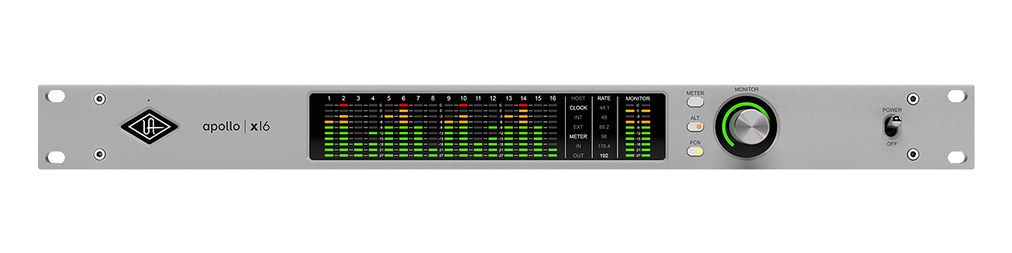
Apollo x16 Gen 2The Apollo x16 is a high-channel-count Thunderbolt interface with exceptional conversion quality, making it ideal as the primary I/O for a Mac-based playback rig. Its 16 analog outputs via DB25 can feed IEM transmitters, FOH sends, and monitoring simultaneously, while UAD onboard DSP provides real-time plugin processing without taxing your playback computer. The Heritage Edition includes a generous bundle of UAD plugins out of the box.View gear →
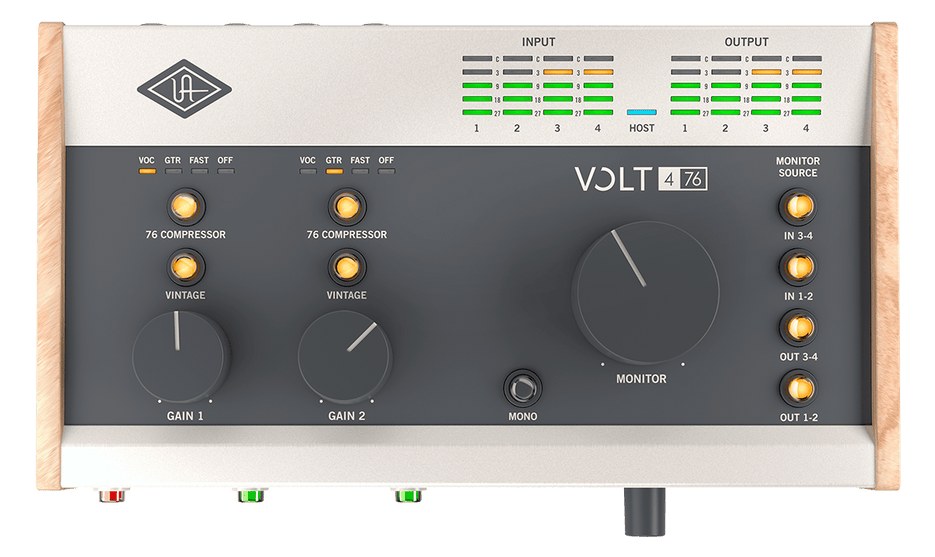
Volt 476The UA Volt 476 brings a taste of Universal Audio's analog heritage to a budget interface, with a built-in 76-style compressor circuit on the inputs that adds analog warmth during tracking. The six outputs are useful for routing separate feeds to IEM transmitters or monitoring, giving you more flexibility than typical desktop interfaces. A solid option for musicians who want quality UA conversion without the Thunderbolt-only Apollo commitment.View gear →
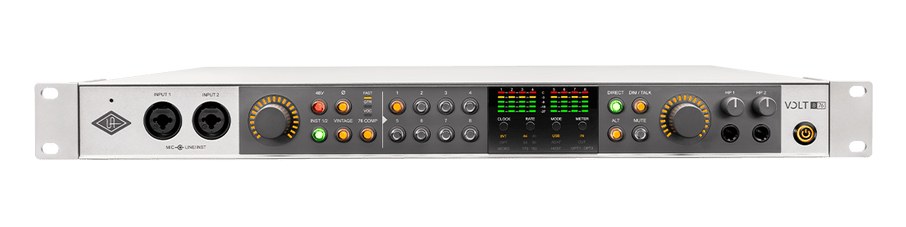
Volt 876The Universal Audio Volt 876 brings the Volt line into the rack: eight vintage-mode preamps, 24-in/28-out USB-C I/O with 32-bit converters, and ADAT expansion in a 1U chassis for under a thousand dollars. It is the budget-Apollo move for band-sized recording and playback rigs that want UA character without DSP pricing. Released late 2025; found missing by the gear-fit auditor.View gear →
06 · Resolve the questions that can change the purchase or build plan.
Planning questions
Short, source-backed answers surface rack fit, power, cabling, and connection details before they become surprises.
How will the Universal Audio Apollo x16D (Dante) affect rack fit and case depth?
It occupies 1U. Its documented depth is 305 mm.
How much power does the Universal Audio Apollo x16D (Dante) draw?
Typical draw is 30W and documented maximum draw is 72W.
What connections does the Universal Audio Apollo x16D (Dante) have?
7 documented physical ports, including Dante Primary, Dante Secondary, Thunderbolt 3 (1), Thunderbolt 3 (2), Word Clock Out, Word Clock In.
07 · See this unit inside a real rack plan.
Builder preview
Placement is only the start. Builder checks space · depth · weight, power headroom, dependencies, and compatible signal paths around this exact catalog item.Open in Builder