
Audio Interface

Universal Audio Volt 876

Universal Audio·Model Volt 876·ua-volt-876

Photos

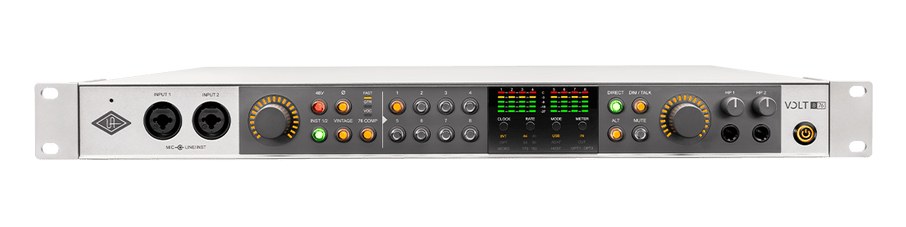
Manufacturer product photography — the drawn faceplate above stays true to panel layout; these show the hardware itself.

Photo: Universal AudioClick to zoom

About the Universal Audio Volt 876

The Universal Audio Volt 876 brings the Volt line into the rack: eight vintage-mode preamps, 24-in/28-out USB-C I/O with 32-bit converters, and ADAT expansion in a 1U chassis for under a thousand dollars. It is the budget-Apollo move for band-sized recording and playback rigs that want UA character without DSP pricing. Released late 2025; found missing by the gear-fit auditor.

The Volt 876 is Universal Audio's first rackmount entry in the Volt line, and it lands in a useful spot: a 1U, USB-C interface with eight combo preamps, 32-bit converters, and ADAT I/O for under a thousand dollars. In a live rig it functions as the central analog-to-digital gateway — the place where microphones, DIs, and line-level sources get digitized and handed off to a DAW or playback host running on a connected laptop or workstation. The vintage-mode preamp character UA built into the desktop Volts carries over here, which means you're getting some of that transformer-style saturation option on every input, not just a clean utility box.

Eight combo inputs across the front cover a full band input list without expansion, and the ADAT port lets you bolt on an eight-channel preamp or converter if the show grows. The 8 TRS line outputs give you enough analog paths to feed IEM transmitters, a console, or both without routing everything through a digital snake. At 15W nominal draw and 2.5 kg in a 210mm-deep chassis, it sits comfortably in a shallow gig rack without fighting for space or power budget. The USB-C connection means your host machine needs a reliable cable and port — at show time that single connection is the entire audio path, so strain-relief it seriously.
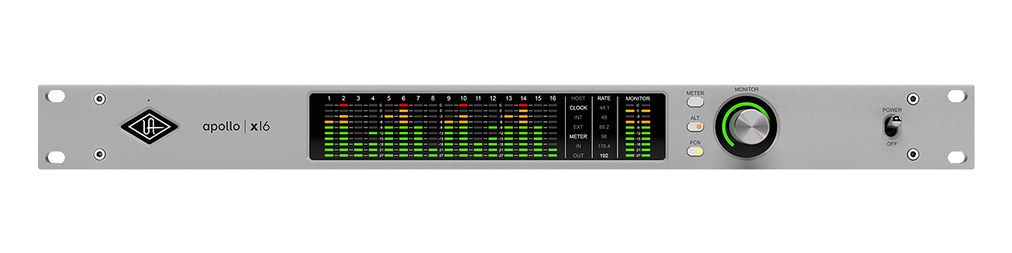
This box makes most sense for a small touring or rehearsal rig where one engineer is running playback and IEM mixes from a laptop, wants real preamps instead of a patchbay full of external pres, and doesn't need Thunderbolt latency or onboard DSP. If you're running Dante or AVB into a digital console, the Volt 876 is the wrong tool — you want a network interface, not a USB box. Similarly, if your workflow depends on UA's LUNA or UAD plug-in processing on the interface itself, this isn't an Apollo; DSP lives in the UAD-2 and Apollo lines, not here. For what it is — an honest, rackmount eight-pre USB interface with expansion room — the price-to-port ratio is hard to argue with.

In the rack

  • Strain-relief the USB-C cable at both ends with a cable lock or adhesive anchor — losing the host connection mid-show drops every input and output simultaneously.
  • Use the ADAT port to add a dedicated headphone amp expander (any ADAT-equipped unit works) so monitor mixes can be distributed without consuming your eight analog line outputs.
  • If your laptop host goes to sleep or the USB bus resets during a set change, the interface will re-enumerate — set your OS power settings to 'never sleep' and disable USB selective suspend before doors open.
  • The Monitor Out L/R is a separate stereo path from Line Out 1–8, which makes it a clean dedicated control-room or engineer's cue feed without touching your main output routing.

First rackmount Volt — 24x28 USB-C, 8 preamps, 32-bit converters (2025).

I/O Ports (7)

PortConnectorDirectionSignalChannels
Mic/Line 1-8COMBO XLR TRSinputanalog audio8
Line Out 1-8TRS QUARTERoutputanalog audio8
Monitor Out L/RTRS QUARTERoutputanalog audio2
ADAT InTOSLINKinputdigital audio
ADAT OutTOSLINKoutputdigital audio
USB-CUSB Cbidirectionaldata
Power
  • Power (IEC C14)

Deciding between two?

Rack space, watts, weight and every connector, side by side.

Related gear

Related articles

Guides from our library that cover planning around audio interface gear.