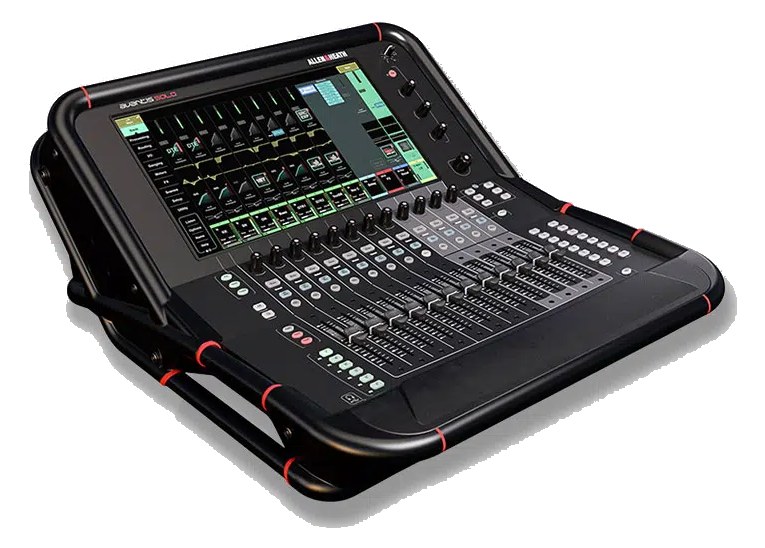
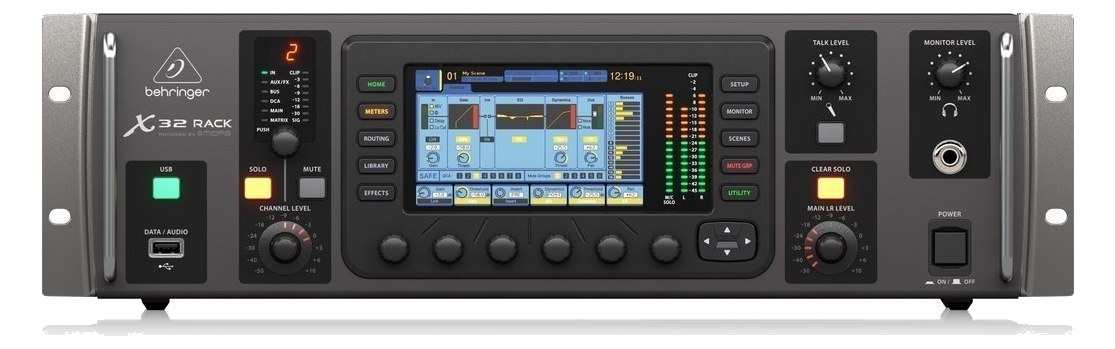
The Allen & Heath Avantis is a 64-channel digital console that combines the SQ-series mix engine with a gigaACE network connection to A&H's DT and DX stage boxes. Two large touchscreens give it a console feel that punches well above its price tier — a popular pick for venues stepping up from an SQ.
~$9,999Use retailer rows for current price and stock
01 · What it does—and what that changes in your rig.
Product overview
Start with the payoff, then work through how it functions, where it fits, and the details that change a real build.
The payoff
Digital Mixer decisions, organized around the whole rig.
The Avantis sits in an interesting middle ground: it's a full-format 64-channel digital console that happens to be rackmountable, which makes it a credible candidate for a monitor-world rack or a sophisticated playback rig that needs real mixing horsepower behind it. Built on Allen & Heath's SQ-series mix engine, it pairs that processing core with dual touchscreens and a proper physical control surface, so it operates like a desk rather than a headless engine. The two gigaACE ports are its main connectivity story — each carries 128 channels bidirectionally over EtherConAn Ethernet plug inside a rugged XLR-style locking shell — tour-grade network connections that can’t be yanked loose., letting you tie into A&H's DT and DX stage boxThe I/O endpoint on stage: mics plug in there and one digital line (AES50, Dante) carries everything to the console. The snake, digitized. ecosystem at serious scale.
Documented outputs
1313 destination connections
Documented inputs
14Based on documented inputs
Rack space
Outside rackPlan a shelf, tray, or stage position
Photo: Allen & HeathOutside rack · 150W
Function
How it works in the path
At load-in, the 12 local XLRThe standard 3-pin locking connector for mics and balanced line signals — pin 1 is the shield, pins 2 and 3 carry the balanced pair. inputs and 12 local XLR outputs give you a working analog patch without any stage boxThe I/O endpoint on stage: mics plug in there and one digital line (AES50, Dante) carries everything to the console. The snake, digitized. at all — useful for smaller shows or emergency fallback scenarios. The dual gigaACE ports support a primary and secondary network path, so redundancyA second copy of anything critical — supply, computer, network path — already running so one failure can’t stop the show. is built into the architecture rather than bolted on. At 22 kg and 580 mm deep, this is not a lightweight drawer; your rack case needs real depth and solid rail support. Power draw sits at 150 W typical with a 200 W maximum, which is well-behaved for what it is, but plan your power conditioning accordingly and don't share a conditioner circuit with anything else that spikes.
Best fit
Where it earns its place in the system
The Avantis makes most sense as a dedicated monitor console or a house desk in a fixed installation where the touchscreen workflow is an asset rather than a liability. If you're building a pure IEMIn-Ear Monitor — earpieces that replace floor wedges, feeding each player their own mix. The reason this whole rack exists. rack around a headless engine for fly-date portability, something like an SQ-5 or SQ-6 in a shallower case will serve you better. If your rig already lives in A&H's gigaACE world — DT168s at stage, DX168s for expansion — the Avantis slots in without protocol translation headaches. Engineers who need deep show-file compatibility with an existing SQ rig will also find the transition familiar, since the processing architecture shares significant DNA.
In the rack
Details worth deciding before load-in.
Measure your rack case interior depth before ordering — 580 mm plus rear cable dressing will push most standard 24-inch cases very close to their limit; a 30-inch deep case is the comfortable choice here.
Run gigaACE Primary to your main stage boxThe I/O endpoint on stage: mics plug in there and one digital line (AES50, Dante) carries everything to the console. The snake, digitized. and gigaACE Secondary as your redundantA second copy of anything critical — supply, computer, network path — already running so one failure can’t stop the show. path or to an expansion DX unit — don't leave the secondary port dark if there's any chance you'll need a fallback mid-show.
The 12 local outputs are a clean solution for IEMIn-Ear Monitor — earpieces that replace floor wedges, feeding each player their own mix. The reason this whole rack exists. transmitter feeds in smaller configurations without the overhead of a full stage boxThe I/O endpoint on stage: mics plug in there and one digital line (AES50, Dante) carries everything to the console. The snake, digitized. run; label and patch them in your show file so you can drop back to local outs if the network has a problem.
If you're integrating with a playback rig feeding stemsSub-mixes of a session grouped by instrument (drums, keys, vocals) — how playback rigs run tracks with live control over each group., the AES3The pro standard for stereo digital audio over an XLR cable — balanced, so it runs much farther than consumer S/PDIF. input is a low-latencyThe delay between sound entering and leaving a digital system. IEM rigs fight to keep the whole chain down to a few milliseconds., clean digital path for a stereo track feed that bypasses any analog stage entirely — worth using when the playback system supports it.
02 · Know the whole path before you buy.
Signal path
Learn the route as a block diagram: source, product function, transport, and destination. Select any block to see what enters, what changes, and what leaves.
Interactive block diagramAuto-looping · hover, focus, or tap to hold a stage
Port-type signalProduct functionSystem boundary
Follow one signal from source to destination
Each block answers the same three questions: what arrives, what changes here, and what leaves.
01 · Source · selected
XLR female + aes3 xlr
etherCON + aes3 xlr
XLR male + aes3 xlr
01 · Source
14 documented inputs
XLR female + aes3 xlr
Arrives as
14 documented inputs
Connector
XLR female + aes3 xlr
Signal
analog audio
03 · What this product asks of the rest of the system.
Compatibility
Treat connector names as the start of the check—not the answer. These are the boundaries that determine a complete working path.
Best fit · Digital Mixer
Use it as digital mixer tracked outside rack rails; follow the manufacturer’s mounting and form-factor guidance.
Plan the companion path
Complete the path with upstream and downstream gear that matches connector, direction, signal type, protocol, and wiring standard.
Connector boundary
Documented connectors: etherCON, XLR female, XLR male, aes3 xlr. Match connector, direction, and signal type—not shape alone.
04 · Every connector, grouped by job.
I/O ports
Switch the product view and the documented port inventory updates with it—hardware and data stay side by side.
Every connector, grouped by job.
Switch panels to keep the hardware view and the documented port list in sync.
Front panelRear panel
All documented ports for Allen & Heath Avantis Digital Mixer
Port
Panel
Connector
Direction
Signal
Channels
gigaACE Primary
rear
etherCON
bidirectional
digital audio
128
gigaACE Secondary
rear
etherCON
bidirectional
digital audio
128
Local Mic In 1
rear
XLR female
input
analog audio
—
Local Mic In 2
rear
XLR female
input
analog audio
—
Local Mic In 3
rear
XLR female
input
analog audio
—
Local Mic In 4
rear
XLR female
input
analog audio
—
Local Mic In 5
rear
XLR female
input
analog audio
—
Local Mic In 6
rear
XLR female
input
analog audio
—
Local Mic In 7
rear
XLR female
input
analog audio
—
Local Mic In 8
rear
XLR female
input
analog audio
—
Local Mic In 9
rear
XLR female
input
analog audio
—
Local Mic In 10
rear
XLR female
input
analog audio
—
Local Mic In 11
rear
XLR female
input
analog audio
—
Local Mic In 12
rear
XLR female
input
analog audio
—
Local Out 1
rear
XLR male
output
analog audio
—
Local Out 2
rear
XLR male
output
analog audio
—
Local Out 3
rear
XLR male
output
analog audio
—
Local Out 4
rear
XLR male
output
analog audio
—
Local Out 5
rear
XLR male
output
analog audio
—
Local Out 6
rear
XLR male
output
analog audio
—
Local Out 7
rear
XLR male
output
analog audio
—
Local Out 8
rear
XLR male
output
analog audio
—
Local Out 9
rear
XLR male
output
analog audio
—
Local Out 10
rear
XLR male
output
analog audio
—
Local Out 11
rear
XLR male
output
analog audio
—
Local Out 12
rear
XLR male
output
analog audio
—
AES3 In
rear
aes3 xlr
input
digital audio
—
AES3 Out
rear
aes3 xlr
output
digital audio
—
USB (recording)
rear
usb b
bidirectional
data
—
Ethernet (control)
rear
RJ45
bidirectional
data
—
Power (IEC)
rear
IEC C14
input
power
—
Showing 31 of 31 documented physical ports. Scroll to review the remaining rows.
05 · Compare the decision, not just the price.
Alternatives
The rows are organized around fit, power, I/O, and system role so a cheaper unit cannot hide a more expensive workflow.
AvantisThe Allen & Heath Avantis is a 64-channel digital console that combines the SQ-series mix engine with a gigaACE network connection to A&H's DT and DX stage boxes. Two large touchscreens give it a console feel that punches well above its price tier — a popular pick for venues stepping up from an SQ.View gear →
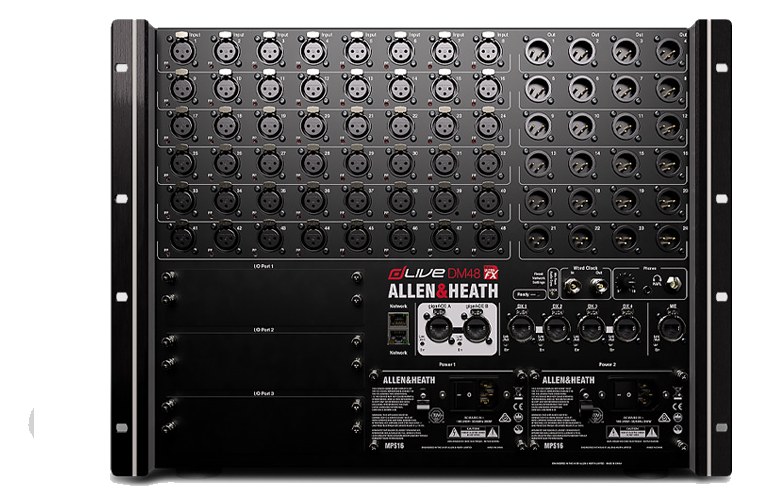
dLive DM48The dLive DM48 is the touring-grade mixrack at the heart of a dLive system — 64 channels of XCVI processing, 64 mic preamps, 32 XLR outputs, and dual gigaACE control links to the surface. Onboard slot accepts Dante, MADI, Waves SoundGrid, or AES67 expansion cards for inter-rig integration. The dLive name has earned trust on touring + theater + worship-large rigs by combining low-latency processing with build quality that survives years of fly dates.View gear →
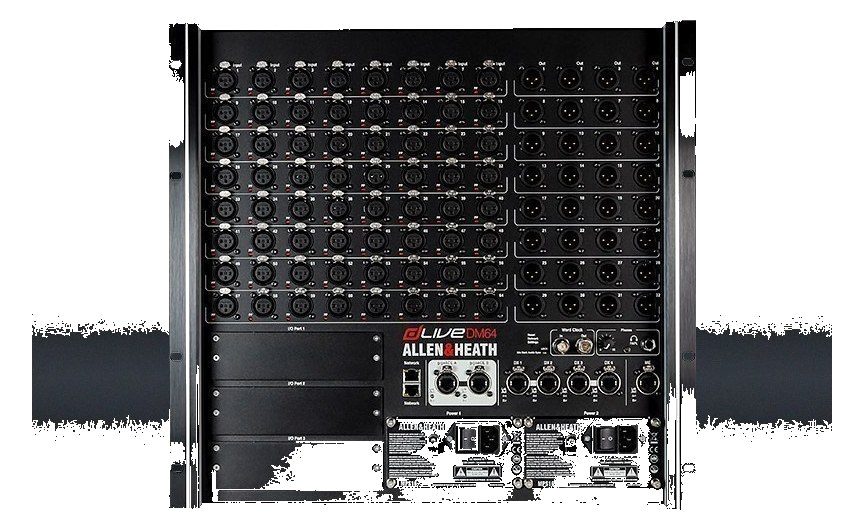
dLive DM64The dLive DM64 is the largest S Class MixRack: 64 mic/line inputs, 32 line outputs and the 128-input / 64-bus XCVI processing engine in a 10U chassis. It is used on major touring rigs that need high stage-I/O density and redundant surface links. It pairs naturally with S5000 or S7000 surfaces and can also run without a surface under network control.View gear →
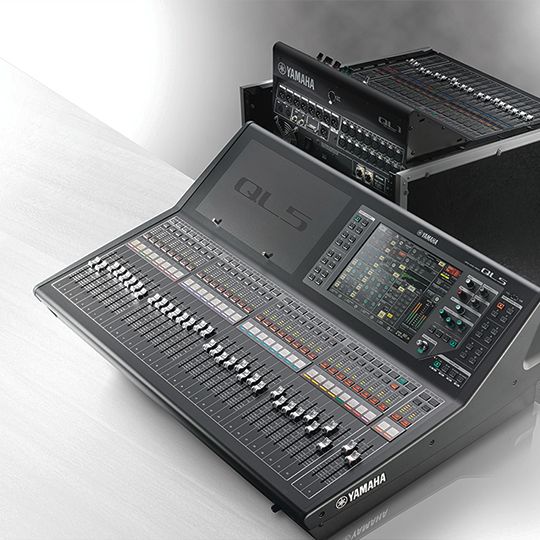
QL5The Yamaha QL5 is the larger of Yamaha's QL-series digital consoles, a long-running staple of touring and theater rigs. It runs on the QL/CL ecosystem with Dante built-in, and pairs naturally with Yamaha Rio and Tio stage boxes. A common front-of-house console for mid-size and large productions.View gear →
06 · Resolve the questions that can change the purchase or build plan.
Planning questions
Short, source-backed answers surface rack fit, power, cabling, and connection details before they become surprises.
Where does the Allen & Heath Avantis Digital Mixer live in a complete rig?
The catalog assigns it no rack units. Builder tracks it as non-rack gear; follow the manufacturer’s mounting, case, and form-factor guidance.
How much power does the Allen & Heath Avantis Digital Mixer draw?
Typical draw is 150W and documented maximum draw is 200W.
What connections does the Allen & Heath Avantis Digital Mixer have?
31 documented physical ports, including gigaACE Primary, gigaACE Secondary, Local Mic In 1, Local Mic In 2, Local Mic In 3, Local Mic In 4.
07 · See this gear inside a complete system plan.
Builder preview
Builder keeps non-rack gear in the same bill of materials, budget, dependency, and connection plan as the rack-mounted system around it.Open in Builder