
Allen & Heath dLive DM48 MixRack
Allen & Heath·Model dLive DM48·allen-heath-dlive-dm48
Photos
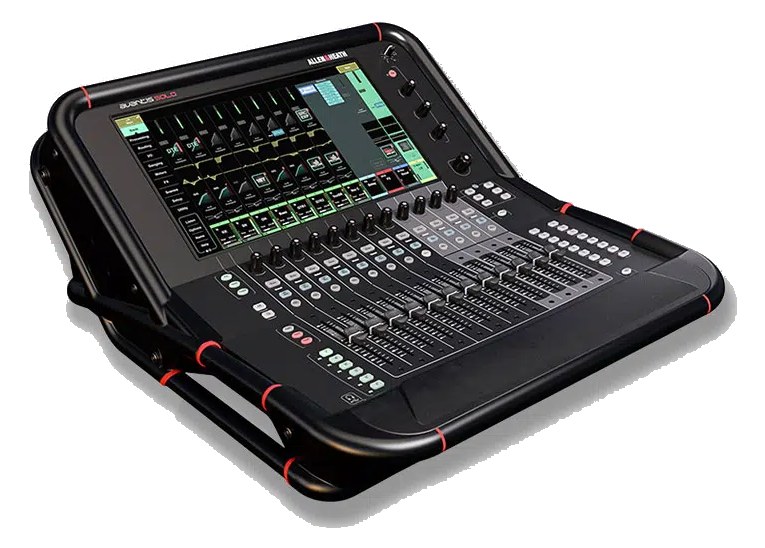
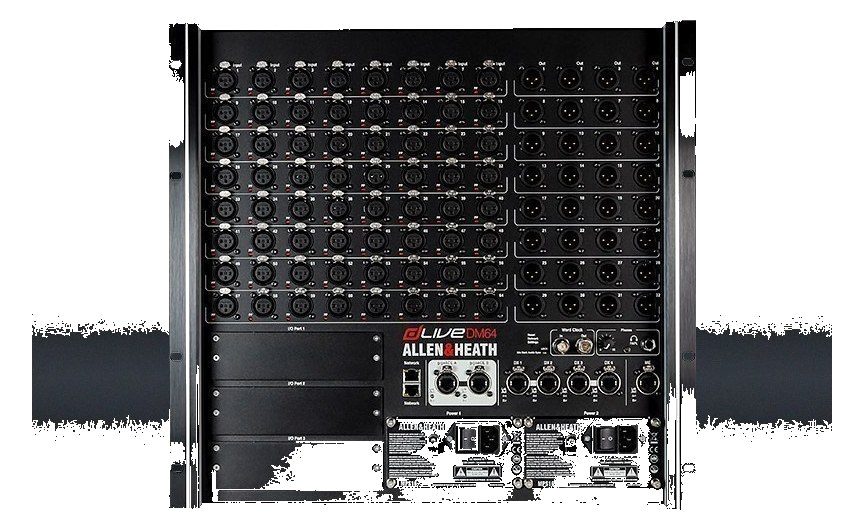
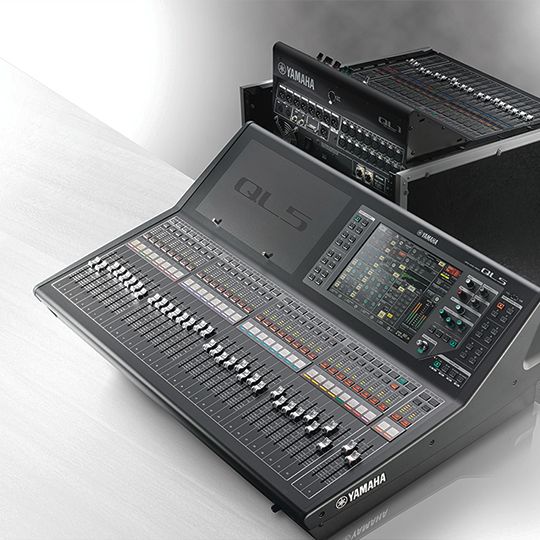
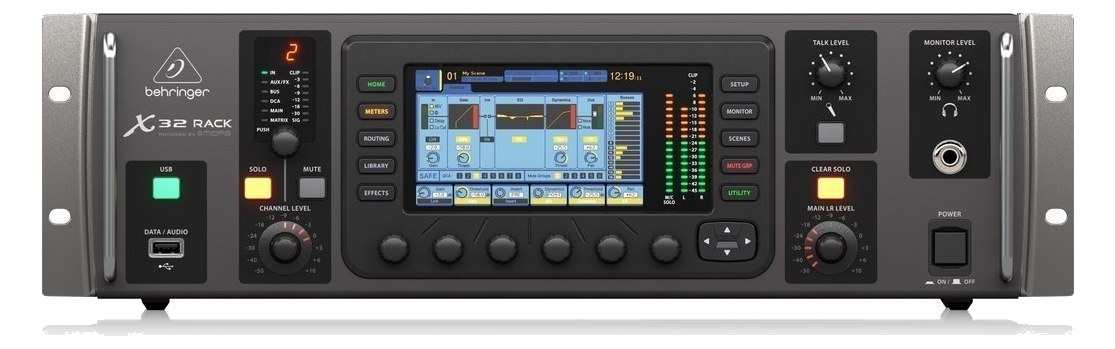
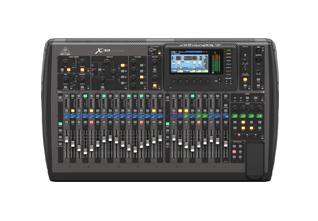
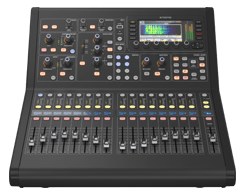
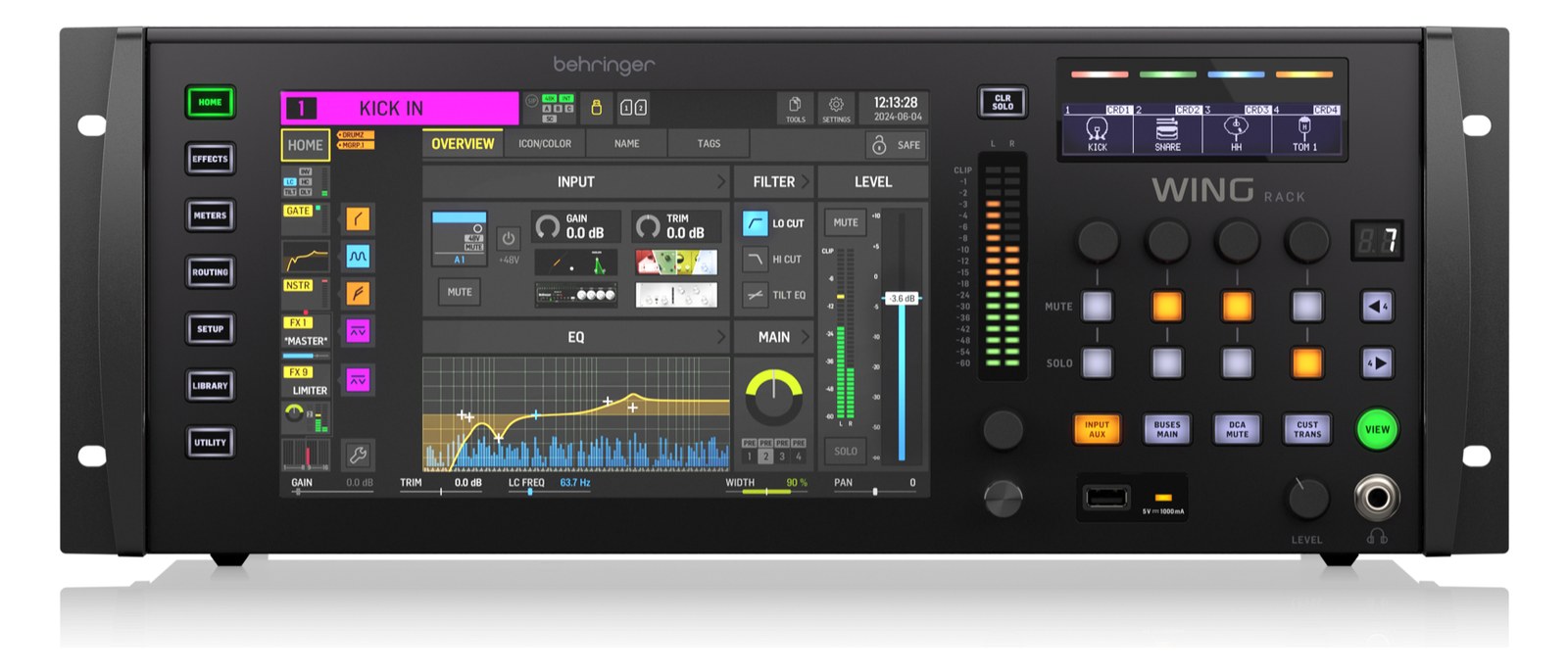
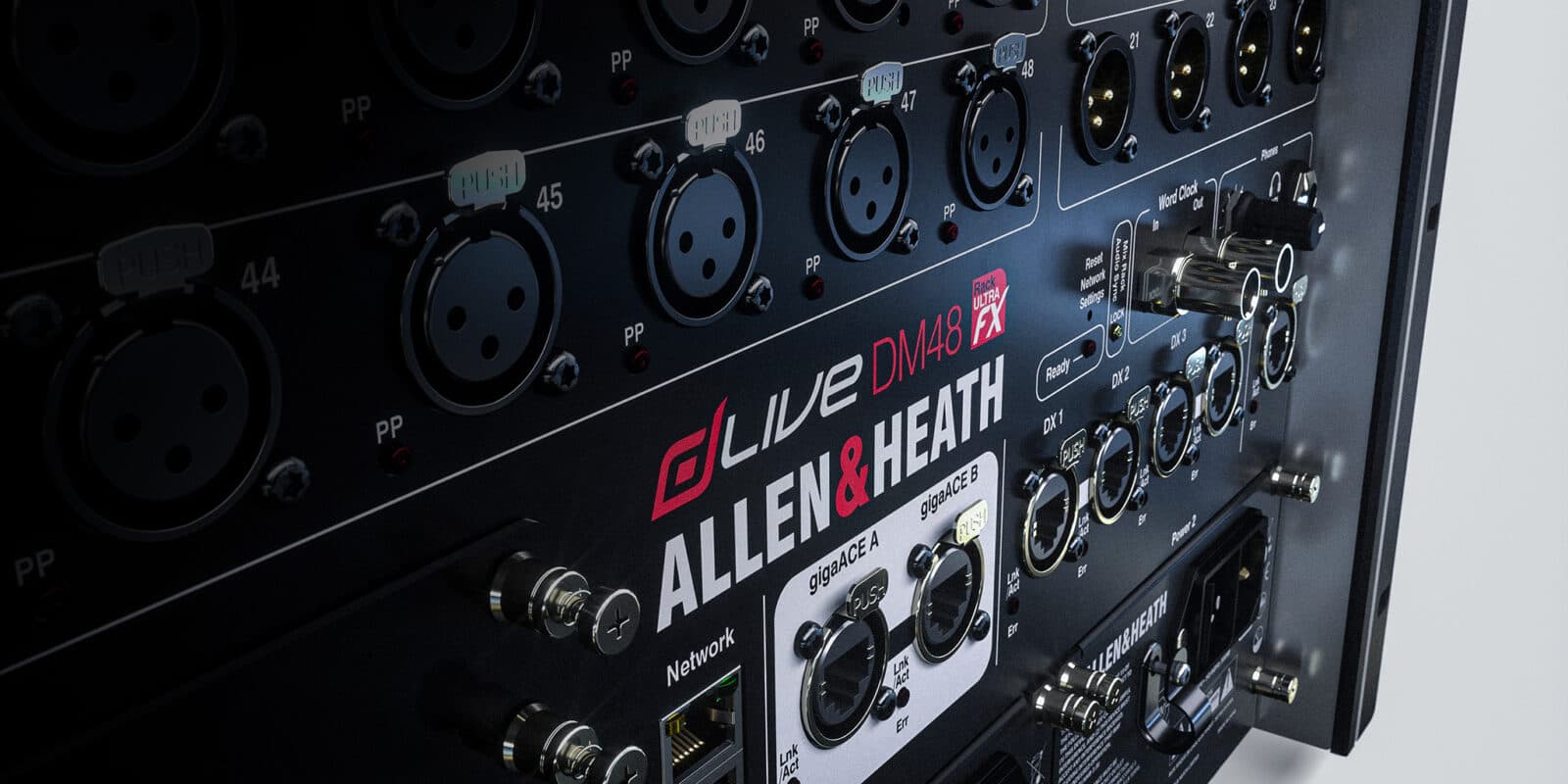
Manufacturer product photography — the drawn faceplate above stays true to panel layout; these show the hardware itself.
About the Allen & Heath dLive DM48
The dLive DM48 is the touring-grade mixrack at the heart of a dLive system — 64 channels of XCVI processing, 64 mic preampsThe gain stage that lifts a mic’s tiny signal up to line level — the first thing a signal hits, and a big part of how a console sounds., 32 XLRThe standard 3-pin locking connector for mics and balanced line signals — pin 1 is the shield, pins 2 and 3 carry the balanced pair. outputs, and dual gigaACE control links to the surface. Onboard slot accepts DanteThe most common audio-over-network standard: dozens of channels of uncompressed digital audio down one ordinary Ethernet cable between Dante boxes., MADIA pro digital format carrying 64 channels on one coax or optical cable. Point-to-point — one sender, one receiver, no network required., Waves SoundGrid, or AES67The interop standard that lets different audio-network flavors (Dante, Ravenna, Livewire) exchange streams on the same network. expansion cards for inter-rig integration. The dLive name has earned trust on touring + theater + worship-large rigs by combining low-latencyThe delay between sound entering and leaving a digital system. IEM rigs fight to keep the whole chain down to a few milliseconds. processing with build quality that survives years of fly datesA gig you fly to instead of driving — the whole rig has to shrink into checkable cases and carry-ons..
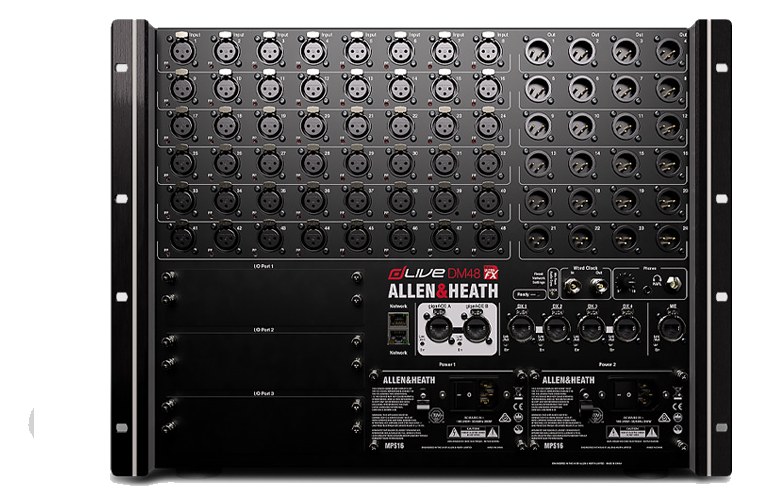
The DM48 is the engine, not the console — it lives in the rack, not at the mix position. What you're looking at is 64 mic preampsThe gain stage that lifts a mic’s tiny signal up to line level — the first thing a signal hits, and a big part of how a console sounds., 32 analog XLRThe standard 3-pin locking connector for mics and balanced line signals — pin 1 is the shield, pins 2 and 3 carry the balanced pair. outputs, and Allen & Heath's XCVI processing core packed into 5U. It pairs with any dLive C-class or S-class surface over gigaACE, which means the brain of your show sits wherever it makes sense — stage left, monitor worldThe side-stage domain of the monitor engineer — console, IEM racks, and everything feeding the band’s ears instead of the audience., a remote truck — while the surface goes where the engineer needs to be. This is the architecture that separates a touring-grade system from a console with a stage boxThe I/O endpoint on stage: mics plug in there and one digital line (AES50, Dante) carries everything to the console. The snake, digitized. bolted on.
At load-in, that 472mm depth and 18.5kg weight are the first things you'll feel — this is a substantive piece of iron and it needs a proper road case and a rack with real rail depth. Power draw runs 110W typical and peaks at 165W, so plan your distroOne pair of antennas feeding many receivers through an amplified splitter — replaces the forest of whips and keeps RF levels consistent. accordingly; the dual IECThe standard three-prong appliance power inlet on rack gear — the kettle lead. C13/C14 in spec-sheet speak. power inputs mean you can feed redundantA second copy of anything critical — supply, computer, network path — already running so one failure can’t stop the show. supplies and sleep better during a four-night run. The four gigaACE ports — two to surface, two to stageboxThe I/O endpoint on stage: mics plug in there and one digital line (AES50, Dante) carries everything to the console. The snake, digitized., each with a redundant companion — mean your critical audio network has a hot spare path at every link. The M-Series option slot gives you DanteThe most common audio-over-network standard: dozens of channels of uncompressed digital audio down one ordinary Ethernet cable between Dante boxes., MADIA pro digital format carrying 64 channels on one coax or optical cable. Point-to-point — one sender, one receiver, no network required., or other protocols for connecting to FOHFront Of House — the main mix the audience hears, and the console position out in the room where it gets mixed., broadcast splits, or a multitrack recorder without burning analog outputs.
If you're running a dLive surface and need a mixrack that won't be the weak point on a tour, a large theater, or a fixed-install worship rig, the DM48 is the right call. The 64-in/32-out analog count handles most large-format applications without an outboard stageboxThe I/O endpoint on stage: mics plug in there and one digital line (AES50, Dante) carries everything to the console. The snake, digitized., and the redundantA second copy of anything critical — supply, computer, network path — already running so one failure can’t stop the show. connections throughout mean this is a show-critical box that's designed to be treated like one. If your input count is under 32 and your budget is tight, the smaller DM0 or DM32 mixracks in the dLive family cover less ground at a lower price point — the DM48 earns its cost when you're regularly near or above 48 channels of analog and need the headroomThe margin between your normal level and where things clip — headroom is what absorbs the snare hit you didn’t see coming. and redundancy that come with it.
In the rack
- Run both IECThe standard three-prong appliance power inlet on rack gear — the kettle lead. C13/C14 in spec-sheet speak. power inputs from separate circuits or a dual-feed power conditionerFilters venue AC, clamps surges, and gives the rack one tidy inlet. Not a voltage regulator and not a battery — just cleaner power. — the redundantA second copy of anything critical — supply, computer, network path — already running so one failure can’t stop the show. PSU is only useful if the two feeds don't share the same breaker.
- Use the gigaACE B ports for your redundantA second copy of anything critical — supply, computer, network path — already running so one failure can’t stop the show. surface link from day one, even if it feels like overkill on the first show; re-cabling mid-tour to add redundancy is always harder than building it into the initial patch.
- If you're integrating with an FOHFront Of House — the main mix the audience hears, and the console position out in the room where it gets mixed. console or broadcast truck via DanteThe most common audio-over-network standard: dozens of channels of uncompressed digital audio down one ordinary Ethernet cable between Dante boxes. or MADIA pro digital format carrying 64 channels on one coax or optical cable. Point-to-point — one sender, one receiver, no network required., populate the M-Series option slot before the rig ships — swapping cards in a fully cabled rack is unpleasant.
- Plan rack depth carefully: 472mm of unit depth plus rear cable bend radius means most shallow touring racks won't close cleanly — measure your case interior before the unit arrives.
64 input / 32 output mixrack — the audio brain of a dLive system. Pairs with any C-class or S-class surface.
I/O Ports (107)
| Port | Connector | Direction | Signal | Channels |
|---|---|---|---|---|
| Mic In 1 | XLR FEMALE | input | analog audio | — |
| Mic In 2 | XLR FEMALE | input | analog audio | — |
| Mic In 3 | XLR FEMALE | input | analog audio | — |
| Mic In 4 | XLR FEMALE | input | analog audio | — |
| Mic In 5 | XLR FEMALE | input | analog audio | — |
| Mic In 6 | XLR FEMALE | input | analog audio | — |
| Mic In 7 | XLR FEMALE | input | analog audio | — |
| Mic In 8 | XLR FEMALE | input | analog audio | — |
| Mic In 9 | XLR FEMALE | input | analog audio | — |
| Mic In 10 | XLR FEMALE | input | analog audio | — |
| Mic In 11 | XLR FEMALE | input | analog audio | — |
| Mic In 12 | XLR FEMALE | input | analog audio | — |
| Mic In 13 | XLR FEMALE | input | analog audio | — |
| Mic In 14 | XLR FEMALE | input | analog audio | — |
| Mic In 15 | XLR FEMALE | input | analog audio | — |
| Mic In 16 | XLR FEMALE | input | analog audio | — |
| Mic In 17 | XLR FEMALE | input | analog audio | — |
| Mic In 18 | XLR FEMALE | input | analog audio | — |
| Mic In 19 | XLR FEMALE | input | analog audio | — |
| Mic In 20 | XLR FEMALE | input | analog audio | — |
| Mic In 21 | XLR FEMALE | input | analog audio | — |
| Mic In 22 | XLR FEMALE | input | analog audio | — |
| Mic In 23 | XLR FEMALE | input | analog audio | — |
| Mic In 24 | XLR FEMALE | input | analog audio | — |
| Mic In 25 | XLR FEMALE | input | analog audio | — |
| Mic In 26 | XLR FEMALE | input | analog audio | — |
| Mic In 27 | XLR FEMALE | input | analog audio | — |
| Mic In 28 | XLR FEMALE | input | analog audio | — |
| Mic In 29 | XLR FEMALE | input | analog audio | — |
| Mic In 30 | XLR FEMALE | input | analog audio | — |
| Mic In 31 | XLR FEMALE | input | analog audio | — |
| Mic In 32 | XLR FEMALE | input | analog audio | — |
| Mic In 33 | XLR FEMALE | input | analog audio | — |
| Mic In 34 | XLR FEMALE | input | analog audio | — |
| Mic In 35 | XLR FEMALE | input | analog audio | — |
| Mic In 36 | XLR FEMALE | input | analog audio | — |
| Mic In 37 | XLR FEMALE | input | analog audio | — |
| Mic In 38 | XLR FEMALE | input | analog audio | — |
| Mic In 39 | XLR FEMALE | input | analog audio | — |
| Mic In 40 | XLR FEMALE | input | analog audio | — |
| Mic In 41 | XLR FEMALE | input | analog audio | — |
| Mic In 42 | XLR FEMALE | input | analog audio | — |
| Mic In 43 | XLR FEMALE | input | analog audio | — |
| Mic In 44 | XLR FEMALE | input | analog audio | — |
| Mic In 45 | XLR FEMALE | input | analog audio | — |
| Mic In 46 | XLR FEMALE | input | analog audio | — |
| Mic In 47 | XLR FEMALE | input | analog audio | — |
| Mic In 48 | XLR FEMALE | input | analog audio | — |
| Mic In 49 | XLR FEMALE | input | analog audio | — |
| Mic In 50 | XLR FEMALE | input | analog audio | — |
| Mic In 51 | XLR FEMALE | input | analog audio | — |
| Mic In 52 | XLR FEMALE | input | analog audio | — |
| Mic In 53 | XLR FEMALE | input | analog audio | — |
| Mic In 54 | XLR FEMALE | input | analog audio | — |
| Mic In 55 | XLR FEMALE | input | analog audio | — |
| Mic In 56 | XLR FEMALE | input | analog audio | — |
| Mic In 57 | XLR FEMALE | input | analog audio | — |
| Mic In 58 | XLR FEMALE | input | analog audio | — |
| Mic In 59 | XLR FEMALE | input | analog audio | — |
| Mic In 60 | XLR FEMALE | input | analog audio | — |
| Mic In 61 | XLR FEMALE | input | analog audio | — |
| Mic In 62 | XLR FEMALE | input | analog audio | — |
| Mic In 63 | XLR FEMALE | input | analog audio | — |
| Mic In 64 | XLR FEMALE | input | analog audio | — |
| XLR Out 1 | XLR MALE | output | analog audio | — |
| XLR Out 2 | XLR MALE | output | analog audio | — |
| XLR Out 3 | XLR MALE | output | analog audio | — |
| XLR Out 4 | XLR MALE | output | analog audio | — |
| XLR Out 5 | XLR MALE | output | analog audio | — |
| XLR Out 6 | XLR MALE | output | analog audio | — |
| XLR Out 7 | XLR MALE | output | analog audio | — |
| XLR Out 8 | XLR MALE | output | analog audio | — |
| XLR Out 9 | XLR MALE | output | analog audio | — |
| XLR Out 10 | XLR MALE | output | analog audio | — |
| XLR Out 11 | XLR MALE | output | analog audio | — |
| XLR Out 12 | XLR MALE | output | analog audio | — |
| XLR Out 13 | XLR MALE | output | analog audio | — |
| XLR Out 14 | XLR MALE | output | analog audio | — |
| XLR Out 15 | XLR MALE | output | analog audio | — |
| XLR Out 16 | XLR MALE | output | analog audio | — |
| XLR Out 17 | XLR MALE | output | analog audio | — |
| XLR Out 18 | XLR MALE | output | analog audio | — |
| XLR Out 19 | XLR MALE | output | analog audio | — |
| XLR Out 20 | XLR MALE | output | analog audio | — |
| XLR Out 21 | XLR MALE | output | analog audio | — |
| XLR Out 22 | XLR MALE | output | analog audio | — |
| XLR Out 23 | XLR MALE | output | analog audio | — |
| XLR Out 24 | XLR MALE | output | analog audio | — |
| XLR Out 25 | XLR MALE | output | analog audio | — |
| XLR Out 26 | XLR MALE | output | analog audio | — |
| XLR Out 27 | XLR MALE | output | analog audio | — |
| XLR Out 28 | XLR MALE | output | analog audio | — |
| XLR Out 29 | XLR MALE | output | analog audio | — |
| XLR Out 30 | XLR MALE | output | analog audio | — |
| XLR Out 31 | XLR MALE | output | analog audio | — |
| XLR Out 32 | XLR MALE | output | analog audio | — |
| gigaACE A to Surface (RJ45) | RJ45 | bidirectional | digital audio | 128 |
| gigaACE B to Surface (RJ45) [redundant] | RJ45 | bidirectional | digital audio | 128 |
| gigaACE Stage A (RJ45) | RJ45 | bidirectional | digital audio | 128 |
| gigaACE Stage B (RJ45) [redundant] | RJ45 | bidirectional | digital audio | 128 |
| AES In (XLR) | AES3 XLR | input | digital audio | — |
| AES Out (XLR) | AES3 XLR | output | digital audio | — |
| M-Series Option Card (Dante / MADI / etc.) | RJ45 | bidirectional | digital audio | 128 |
| Network (RJ45) | RJ45 | bidirectional | data | — |
| Word Clock In (BNC) | BNC | input | digital audio | — |
- Power A (IEC) (IEC C14)
- Power B (IEC) [redundant] (IEC C14)
Deciding between two?
Rack space, watts, weight and every connector, side by side.
Related gear


Related articles
Guides from our library that cover planning around digital mixer gear.
A walking tour of the signal path from microphone to in-ear monitor, with what every box in the rack actually does to the audio along the way.
Why sealed IEMs make you feel disconnected from the room — and exactly how to put the audience back into your mix with one or two well-placed mics.
Step-by-step: linking aux buses into stereo pairs, pre-fader vs post-fader, routing buses to Ultranet vs physical XLRs vs AES50, and adding a bus-level limiter.
A practical comparison of the three audio-over-network protocols you’ll encounter in a rack rig, with guidance on when each one is the right pick.